
Weak turnout seen in Myanmar's phased election, first since 2021 coup
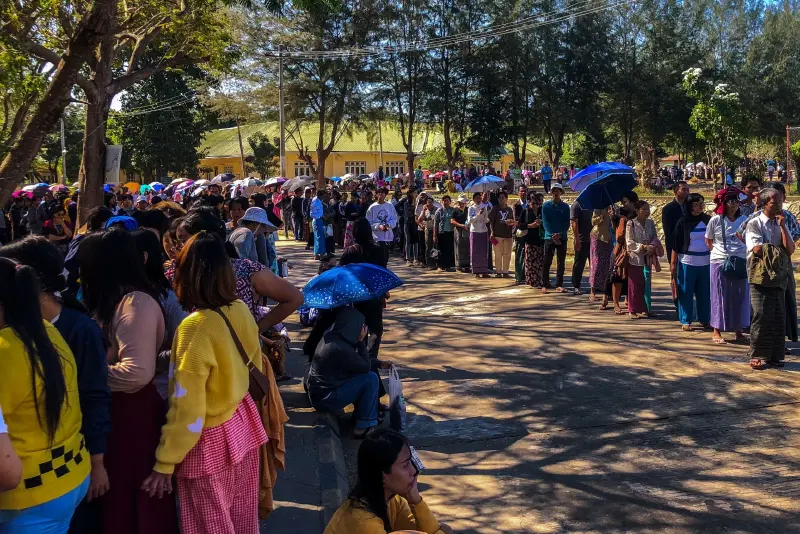


Myanmar’s first election since the 2021 coup began with a muted opening round on Sunday, as the initial phase of a staggered general poll closed amid civil war, tight restrictions and widespread doubts over credibility. Residents in multiple cities said turnout looked noticeably weaker than in past elections.
The military government, which seized power in 2021 and later crushed pro-democracy protests, insists the vote will restore political stability in the impoverished Southeast Asian nation.
But the process has been condemned internationally, with the United Nations, some Western governments and rights groups arguing it cannot be considered free or fair because anti-junta parties are not taking part and criticism of the election is illegal.
Aung San Suu Kyi, the Nobel Peace Prize laureate removed in the coup, remains in detention. Her National League for Democracy, which won a landslide in the 2020 election, has been dissolved.
Military-linked party tipped to dominate
With major opponents sidelined, the military-aligned Union Solidarity and Development Party (USDP) is widely seen as the frontrunner. The party, led by retired generals, is fielding around one-fifth of all candidates despite sharply reduced competition, according to Lalita Hanwong, a lecturer and Myanmar specialist at Thailand’s Kasetsart University.
She said the election was designed to extend military control, with the USDP and other aligned parties expected to combine forces to form the next government.
Campaigning ahead of the vote was subdued, but the USDP was the most visible presence. Founded in 2010, it won an election boycotted by the opposition that year and governed with military backing until 2015, when Suu Kyi’s NLD swept it from office.
Turnout appears thinner; voting to continue in January
Ten residents across cities around Myanmar said Sunday’s voter participation appeared far lower than in 2020. Further rounds are scheduled for January 11 and January 25, covering 265 of Myanmar’s 330 townships, although the junta does not fully control all of those areas.
Since the coup, armed groups that emerged in response, alongside long-established ethnic forces, have battled the military across large parts of the country. The conflict has displaced about 3.6 million people and fuelled one of Asia’s most severe humanitarian crises. No date has been announced for the final election result.
In Naypyitaw, junta chief Min Aung Hlaing voted in the heavily guarded capital, according to state media footage, later raising an ink-stained finger, a measure used to prevent repeat voting.
Asked whether he wanted to become president, a role analysts say he covets, he told reporters he was not the leader of any political party, adding that the presidency is chosen through a parliamentary process once lawmakers convene.
International rejection, junta promises “better future”
Analysts have warned that the junta’s effort to project stable governance while the war continues carries significant risks, and that broad international recognition is unlikely for any military-run administration with a civilian facade.
Tom Andrews, the UN special envoy for human rights in Myanmar, said the election was not a route out of the crisis and should be firmly rejected. Junta spokesperson Zaw Min Tun acknowledged the criticism but said the vote would produce political stability and a “better future”.
Residents said the atmosphere in major cities such as Yangon and Mandalay was far quieter than in the last election, which was held under COVID-19 restrictions. The Asian Network for Free Elections said Myanmar’s election rules set no minimum turnout threshold.
In Yangon, some polling booths, including those near military-family housing, had lines by midday, but others were largely empty, residents said. In Mandalay, one resident described the mood as far less energetic than in 2020.
In Hakha, the capital of Chin state, where fighting continues, residents said streets were deserted after a local rebel group urged a boycott. One 63-year-old man said nobody in his neighbourhood went to vote, adding that they were not interested in the election.
Reuters
