
Lao Communist Party Congress to open Tuesday, elect new leaders
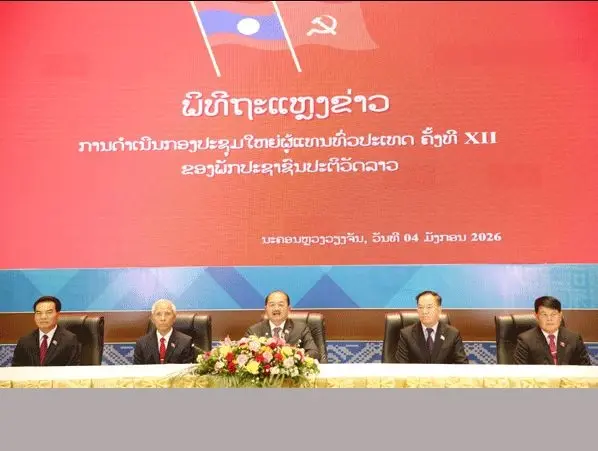


The Lao People’s Revolutionary Party (LPRP) will open its 12th National Congress on Tuesday (January 6) to elect the new Party leadership and outline the country’s development direction over the next five years.
The congress will take place over three days from January 6-8, Politburo member and Head of the Congress Secretariat, Prof Kikeo Khaykhamphithoune said at a press conference on Sunday.
A total of 834 delegates, including 123 women, will attend the congress, representing 421,865 Party members across the country.
Delegates were elected from Party committees at the ministerial level, equivalent organisations and provinces, and represent a wide range of social backgrounds, ethnic groups, genders, and age groups. An additional 388 guests will also attend.
Kikeo said the Congress is a major political and historical event for the Party and the nation.
Held once every five years, the congress will review achievements made in implementing the resolution adopted by the last congress and set the direction of development for the next five years.
The congress will take the theme “Elevate the Party’s strong leadership role, actively build an independent and self-reliant economy, continue to nurture the people’s democratic regime, and advance steadfastly towards socialism.
Delegates will consider and adopt the drafts of four key documents, namely the Party’s third political project, the political report of the 11th Party Central Committee, the 10th five-year National Socio-Economic Development Plan for 2026-2030, and Party regulations relating to the 12th Central Committee.
“These documents will determine the Party’s political strategy and guidelines, organisational guidelines, and the State’s socio-economic development direction over the coming years, taking into account Laos’ particular circumstances,” Kikeo said.
The congress will also elect the new 12th Party Central Committee, the Party’s highest leading body that will shape policies in the new term. The newly elected committee will then choose the Party Secretary General, members of the Politburo, and elect members of other key Party bodies.
Kikeo said preparations for the congress began in 2023 and involved wide-ranging consultation at the central and local levels, including with friendly countries, to ensure the documents reflect the collective wisdom of the Lao people.
The congress takes place ahead of several other important political events scheduled for early this year.
Following the congress, new National Assembly members will be elected in nationwide polling on February 22. The new legislature of the National Assembly will later elect the State President, Prime Minister and other top leaders, approve the new government cabinet, and endorse the five-year national development plan.
Daily news updates will be released throughout the congress, and a full report will be presented to the public following its conclusion, Kikeo said.
Party to highlight 2021–2025 achievements as it convenes 12th Congress
LPRP will convene its Congress, with one of the key agendas being to highlight achievements made over the past five years under the guidance of the current Party leadership.
Despite numerous challenges, Laos has recorded notable achievements over the past five years.
Benefiting from political stability conducive to socio-economic development, Laos is expected to achieve average annual economic growth of 4.24 % during the 2021–2025 period, exceeding the target of 4 %, Prime Minister Sonexay Siphandone told the National Assembly in November.
The growth reflects the country’s recovery and resilience amid domestic and global turbulence. Key drivers have included agriculture, electricity generation, mining, processing industries, transport, and tourism.
These outcomes are the result of efforts to implement the 9th Five-Year National Socio-Economic Development Plan (2021–2025), which serves as a key instrument for translating the 11th Party Congress resolution into action.
Over the five years, the agricultural sector grew by an average of 2.9 %, accounting for 19.4 % of GDP. The industrial sector expanded by 4.7 %, contributing 32.5 % of GDP, while the services sector grew by 4.5 % and accounted for 36.6 % of GDP.
Major infrastructure projects, including the Laos–China Railway and the establishment of three dry ports in Vientiane as well as Savannakhet and Champasak provinces, have strengthened regional connectivity and boosted logistics, trade, investment, and tourism.
On the fiscal front, improved revenue collection through the modernisation of tax and customs systems has helped reduce the budget deficit and improve the efficiency of public spending. As a result, debt servicing has improved, with public debt declining from 116 % of GDP in 2022 to 88 % in 2025.
Progress has also been made in poverty reduction, with the proportion of people living below the poverty line falling from 18.3 % in 2019 to 15 % in 2025.
Efforts to strengthen governance have gained momentum through structural reforms, including the reduction of ministries from 17 to 13 to enhance efficiency. The number of central government departments was cut from 158 to 124, while provincial departments declined from 574 to 502.
The government has continued to improve the business environment. Over the past five years, 14 new one-stop service centres have been established, bringing the nationwide total to 75.
However, implementation of the 9th National Socio-Economic Development Plan has faced significant challenges, including domestic financial constraints, the lingering impacts of the Covid-19 pandemic, natural disasters, and global economic volatility.
Although economic growth has been maintained, its quality and sustainability remain limited, as expansion is still largely driven by unprocessed natural resources with low value-added and limited job creation, according to a Ministry of Finance report.
While the economy has grown, people’s real incomes remain low, and commercial production and productivity are insufficient and undiversified, Deputy Minister of Finance Phonevanh Outhavong told a seminar in Vientiane in October.
Inflation, though declining, remains high, along with currency depreciation, which has weakened purchasing power. Average inflation over the five years is projected at 17.81 %, well above the target of less than 6 %, while kip depreciation is expected to average 15.15 %, exceeding the target range of ±5 %.
Phonevanh stressed the need to streamline investment approval processes and accelerate the cross-border movement of goods.
Other challenges requiring decisive action include rising dropout rates in primary and lower secondary schools, a persistent shortage of teachers, and increasing labour migration abroad, which has exacerbated domestic labour shortages.
Building on the achievements and lessons of the 11th National Party Congress and the implementation of its resolution, the upcoming 12th Congress is scheduled to discuss and adopt a new resolution that will chart the country’s development direction for the next five years, providing crucial guidance as Laos aims to graduate from least developed country status by 2026.
The Vientiane Times
Asia News Network
