
Bending the bamboo: Thailand turns neutrality into a diplomatic advantage
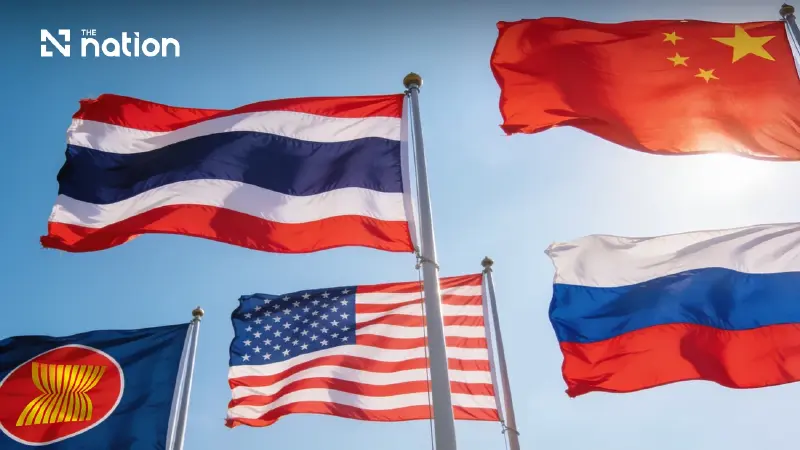


Thailand’s modern “bamboo diplomacy” is becoming a powerful asset, helping the kingdom attract investment, bridge global divides and strengthen ASEAN’s role in a volatile world.
In a world that increasingly asks nations to choose sides, Thailand’s quiet answer is becoming one of its most valuable exports: balance. The kingdom’s old instinct for “bamboo diplomacy” — bending with the wind without breaking — is being updated for a fragmented 2026, where geopolitical agility is no longer a luxury but an economic strategy.
This is not passive neutrality. It is active positioning. Thailand’s official foreign-policy direction calls for a “multi-dimensional and multi-directional” approach, rooted in multilateralism, international law and a stronger role for ASEAN in a shifting global landscape. In plain terms, Bangkok is choosing usefulness over confrontation.
That usefulness matters. As global supply chains split, companies are searching for places that are open to the United States, close to China, trusted by Japan, connected to ASEAN and still comfortable speaking to everyone else. Thailand’s answer is not to shout ideology, but to offer predictability: industrial estates, ports, digital infrastructure, skilled manufacturing and a diplomatic culture that keeps doors open.

The investment results are already visible. Thailand’s Board of Investment has set out a long-term semiconductor strategy, targeting power chips, sensors, photonics, discrete devices and analogue chips as part of a plan to build a fuller value chain. Reuters also reported in May that Thailand approved six major projects worth 958 billion baht, led by data infrastructure investment, reinforcing the kingdom’s ambition to become a regional digital hub.
This is where neutrality becomes a service. For modern CEOs, Thailand offers a rare proposition: a market where investment can move without becoming trapped in the emotional weather of great-power rivalry. It is not just a base for factories, but a platform for “reglobalisation” — the rebuilding of trade networks in ways that are more resilient, diversified and politically survivable.
Diplomatically, Thailand is also leaning into its role as a bridge. Reuters reported this year that Thailand hopes to help bring Myanmar back into ASEAN’s fold, reflecting Bangkok’s preference for dialogue, proximity and regional problem-solving. At the same time, Thailand continues to support ASEAN Centrality, a principle that gives smaller and middle powers collective weight in a world dominated by giants.
The beauty of Thailand’s new neutrality is that it feels deeply traditional and sharply modern at once. It is bamboo with broadband; diplomacy with logistics; soft speech backed by hard infrastructure.
In 2026, Thailand’s competitive edge may not be choosing one camp over another. It may be ensuring that, whatever the camp, everyone still needs a gateway — and that gateway is Thai.
