
Thailand seeks deeper Russia ties as ASEAN trade potential grows
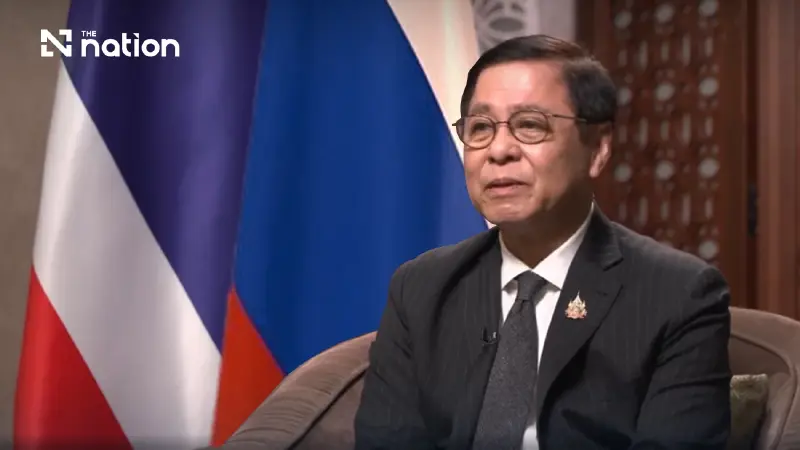


Thailand is seeking closer partnership with Russia, as Foreign Minister Sihasak Phuangketkeow says ASEAN-Russia trade remains below potential and can grow through energy, technology and private-sector cooperation.
- Thailand's Foreign Minister stated that current trade between ASEAN and Russia, at around $7 billion, is significantly below its potential and should be expanded.
- The push for deeper ties is intended to be driven by the private sector, with both sides showing keen interest in expanding trade and investment.
- Potential areas identified for increased cooperation include energy, information technology, the creative economy, science, innovation, and space technology.
- Amid global supply-chain disruptions, Thailand sees Russia as a key partner for diversifying its sources of oil, gas, and fertilizer to improve energy security.
Thailand is seeking to deepen cooperation with Russia, with Foreign Minister Sihasak Phuangketkeow saying ASEAN-Russia trade remains far below its potential and should be driven more strongly by the private sector.
Speaking in an interview with RT, the Russian state-controlled international television network, during the ASEAN-Russia summit on Thursday (June 18), Sihasak noted that the two sides were marking 35 years of relations.
He said the milestone should be used not only to review past achievements, but also to identify new areas of cooperation between ASEAN and Russia.
Sihasak stressed that peace, stability and the rules-based international order should remain central to the partnership.
“I think one thing is clear: we want to work together to maintain peace and stability in our region and in the world because we have so many conflicts,” he said.
He added that ASEAN and Russia “see eye to eye” on the need to uphold multilateralism, while economic cooperation should gain stronger momentum.
The ASEAN-Russia Business Forum had shown that private sectors on both sides were keen to expand trade and investment, Sihasak noted. Given the scale of Russia’s economy and ASEAN’s combined economies, he described current trade levels as below potential.
“Right now, I think our total trade is about US$7 billion. With Thailand only about US$1 billion, I think we can do much more,” he said.
Potential areas for deeper cooperation include energy, information technology, the creative economy, science and innovation, and space technology.
“So, we’re looking forward to doing more together, not just at the level of governments, but also having our private sector be the driving force in our partnership,” he said.
Conflict exposes supply-chain and energy risks
Asked how deeper ASEAN-Russia cooperation and stronger trade could help ease global supply-chain disruption, Sihasak pointed to the impact of recent events in the Middle East, describing the conflict as one that should not have begun.
He noted that the fighting had caused losses, destruction and suffering for countries in the region, while also affecting Thailand and other ASEAN economies through energy-supply disruption, higher petrol prices and shortages.
The disruption underlined the importance of maritime security, especially at strategic chokepoints, and showed how closely shipping routes are linked to energy security.
Sihasak observed that Thailand and other countries had been reminded of their heavy dependence on fossil fuels, even as they needed to move more decisively towards new energy sources, including clean and renewable energy.
He also emphasised the need to diversify supply sources. Russia, he noted, is a major producer of oil, gas and fertiliser, while other countries could also help strengthen energy resilience.
“We have to diversify and look to alternative sources for our energy supply,” he said.

Thailand seeks balance in a changing world order
Sihasak described the current global environment as “challenging times”, saying the international order shaped after World War II no longer fully reflects present-day realities.
“The world order as conceived after World War II doesn’t reflect the realities of the present day anymore,” he said, adding that the system needed to better reflect the diffusion of power, the rise of a multipolar world and the voice of the Global South.
For Thailand, he explained, the challenge is to navigate geopolitical, geoeconomic and geotechnological competition without being drawn into rival blocs.
Sihasak said Thailand needed agile diplomacy that could adjust and adapt while keeping national interests in mind. ASEAN unity, he added, would be central to helping member states manage global contestation.
He also noted that Thailand, like many other countries, needed to maintain strategic autonomy, although doing so required careful balancing.
“And that’s a little bit difficult. It involves balancing, trying to adjust, adapt, bearing in mind where our interest lies,” he said.
