
Study plans for Samui and Pattaya cruise terminals sent back for review
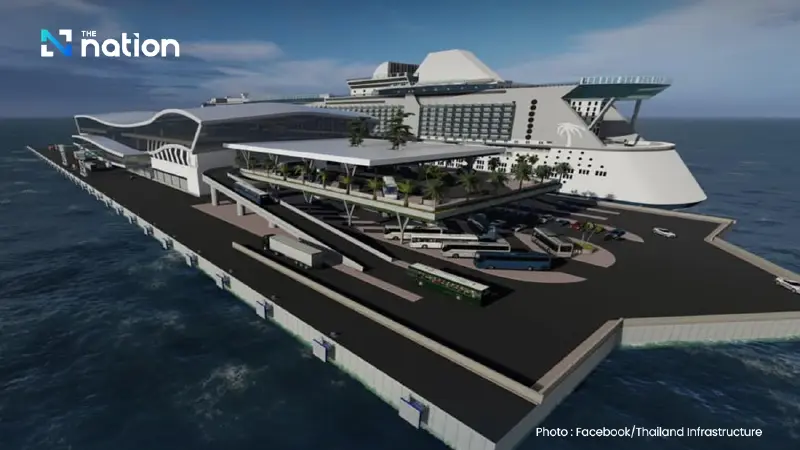


The PPP Committee has rejected the current study plans for the proposed cruise terminal projects in Ko Samui and Pattaya, instructing the Marine Department to conduct new Environmental and Health Impact Assessment (EHIA) reports for both sites.
The Marine Department is pressing forward with plans to develop cruise terminals capable of accommodating large vessels, particularly in Ko Samui, Surat Thani, and Pattaya, Chon Buri.
The projects are seen as key to elevating Thailand into a regional hub for marine tourism.
Kritphet Chaichuai, Director-General of the Marine Department, said the Ko Samui Cruise Terminal project is currently under review.
The Public–Private Partnership Policy Committee (PPP Committee) has instructed the department to resubmit an Environmental and Health Impact Assessment (EHIA) report, causing the project timeline to be extended.
In line with this directive, the department has requested a 2026 budget allocation of around 5 million baht to hire a consulting firm to prepare the EHIA, which is expected to be completed by early 2027.
Once the report is ready, the project will be submitted to the PPP Committee, the Transport Ministry and the Cabinet for approval between late 2027 and early 2028.
If approved, the department expects to launch the bidding process under a 30-year public–private partnership (PPP) concession by 2029, select a winning bidder, and commence construction.
The terminal would take about three years to build, with operations targeted to begin around 2032.

Kritphet noted that both foreign cruise operators and domestic companies have expressed interest in joining the project. However, final commitments will depend on how economic and tourism conditions develop in Thailand and abroad in the near term.
“The decision to adopt a PPP model is to bring in private partners with expertise and experience in port management, particularly in mobilising funding for such large-scale projects,” he explained.
A feasibility study identified Hin Khom Cape in Taling Ngam subdistrict, Ko Samui, as the most suitable location for the cruise terminal. The designated site covers 47 rai, 38 square wah (around 7.6 hectares).
The project carries an estimated investment of 6.415 billion baht, consisting of 6.009 billion baht in the state budget and 406 million baht through PPP arrangements. The investment will be structured as a PPP Gross Cost model under a 30-year concession.
The development plan includes a passenger terminal building of at least 7,200 square metres, capable of handling 1,200 passengers per hour. The pier itself will accommodate two cruise ships simultaneously:
- One large cruise ship carrying up to 4,000 passengers
- One medium-sized cruise ship with a capacity of 2,500 passengers
In addition, the port will be able to host up to 80 yachts and six ferries. The pier will measure 362 metres in length, with a 12-metre-deep navigation channel, and the terminal building is designed to handle a maximum capacity of 3,600 passengers at any one time.

Kritphet further updated on the proposed cruise terminal project at Bali Hai Cape in Pattaya, Chon Buri, located in the upper Gulf of Thailand.
He said the project remains in the study phase and will only proceed after the EHIA for the Ko Samui cruise terminal has been completed.
“The Marine Department aims to develop Pattaya’s cruise terminal as a home port, which makes it necessary to conduct a new EHIA as well. While awaiting progress, Laem Chabang Port in Chon Buri currently has passenger facilities that can accommodate cruise travellers,” Kritphet said.
He added that most of the land acquisition for the Pattaya project involves over 40 rai of offshore areas, meaning the development would not significantly affect local communities on land.
The proposed Pattaya Cruise Terminal at Bali Hai Cape carries an estimated investment of 7.412 billion baht, divided into two major components.
- Capital expenditure: 5.934 billion baht, which includes:
- Offshore infrastructure construction: 4.315 billion baht
- Cruise berth and passenger terminal: 2.881 billion baht
- Connecting bridge: 675 million baht
- Car park: 567 million baht
- Passenger pier and speedboat facilities: 192 million baht
- Equipment: 400 million baht
- Land acquisition: 608 million baht
- Elevated road: 1.611 billion baht
- Operation and maintenance (O&M) : 1.478 billion baht
The project is designed as a hybrid terminal, serving both as a home port for passenger ships carrying up to 1,500 people and as a port of call for international cruise liners.
The facility will be capable of handling cruise ships with 3,500–4,000 passengers, with the terminal located around 1 kilometre offshore to minimise land acquisition. The port will accommodate large vessels with draughts of 12–14 metres, including two mega cruise ships of up to 236,000 gross tonnage simultaneously.
The total quay length will be 420 metres, while the passenger terminal will be equipped to handle 3,500–4,000 people per trip. Facilities will include waiting halls, security screening areas, 60 check-in counters, 26 immigration counters, and baggage handling systems.
Supporting infrastructure will comprise parking facilities for 132 cars and 82 buses, ensuring seamless connectivity for tourists arriving at the port.

