
Akazawa urges the US to exempt Japan from the blanket tariff hike
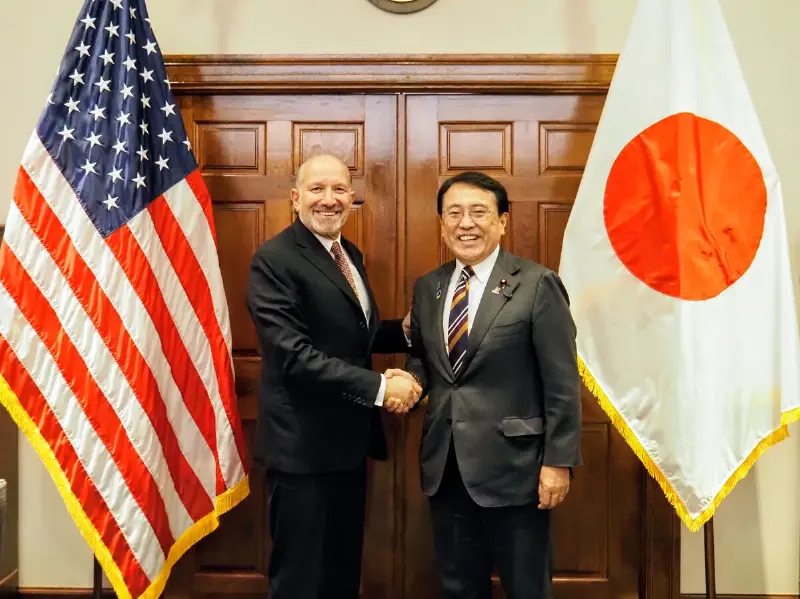


Japanese trade minister Ryosei Akazawa on Friday urged the United States to exempt Japanese firms from a planned worldwide increase in tariffs from 10% to 15%.
In a roughly two-hour meeting with US Commerce Secretary Howard Lutnick, Akazawa called on Washington to ensure that tariff rates applied to Japan under new measures would not be less favourable than those in place. The Japanese minister did not disclose to reporters after the meeting how the US government responded to the request.
The two also discussed the second installment of Japan's pledge to invest 550 billion dollars in the United States. But Akazawa declined to disclose details, only saying that the two countries will "cooperate closely" so that the upcoming meeting between Japanese Prime Minister Takaichi Sanae and US President Donald Trump will be "fruitful."
Next-generation nuclear reactor and copper refinery construction are considered for the second-round investment.
The blanket 10 % tariff, based on Section 122 of the US Trade Act, is not subject to mitigation measures introduced for the now-suspended reciprocal tariff on Japan, and is added on top of existing tariffs. This has increased the tariff burden for some products.
Akazawa urged the US government to rectify this situation and to exempt Japan from other tariff measures not included in a Japan-US trade agreement.
The Japanese minister asked Lutnick not to subject Japanese firms to another levy being considered by Washington, which would be based on Section 301 of the Trade Act, which enables the US government to address unfair foreign trade practices. He also requested that no new additional measures be applied, likely bearing in mind the possibility of a new levy based on Section 232 of the Trade Expansion Act, the basis of existing auto tariffs.
The Japan-US trade deal included a mitigation measure for the reciprocal levy, not placing additional tariff burdens on Japanese goods already subject to levies of 15 pct or more and capping the total tariff rate on other goods to 15 %. While the reciprocal tariff was initially implemented as an add-on to existing tariffs, the mitigation measure was retrospectively applied following ministerial-level talks.
The Trump administration was forced to suspend its reciprocal tariffs after the US Supreme Court found them unconstitutional. Washington instead imposed a blanket 10 % tariff on all countries, and Treasury Secretary Scott Bessent indicated that the rate could be hiked to 15 % soon.
The European Union, which had also agreed with Washington on mitigation measures for reciprocal tariffs, has received a commitment from the US government to maintain the blanket tariff rate at 10 %, according to US media reports. The European Parliament has frozen a trade deal with the United States, citing significant uncertainty about new tariff measures, including the possibility of increased tariffs on certain items.

[Copyright The Jiji Press, Ltd.]
