
Cost of cleanup could exceed Bt100 bn
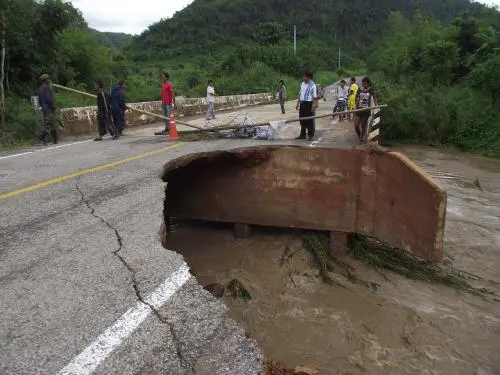


Thailand's flood-rehabilitation bill could exceed Bt100 billion as flood waters continue to claim victims and disrupt the supply chain, with Japanese carmakers alone facing losses of up to US$500 million (Bt15.3 billion) as the disruptions threaten to fo
Manufacturers yesterday rushed to address fears of a consumer-goods shortage, while the Bank of Thailand (BOT) offered assurances that all Thai banks had sufficient strength to handle a rise in the number of business loans turning sour.
According to the Labour Ministry, 10,827 factories in 17 provinces are flooded, affecting 446,777 workers. The focus is now on the nation’s first industrial estate, Nava Nakorn Industrial Estate, which houses 227 factories and employs over 170,000 workers.
Voravidh Champeeratana, deputy director of the Budget Bureau, said yesterday that the reconstruction budget will be increased to Bt130 billion from an earlier estimate of Bt80 billion, and that the Cabinet will today consider widening the 2012 budget deficit by Bt50 billion to Bt400 billion. Finance Minister Thirachai Phuvanatnaranubala yesterday mentioned the likelihood of widening the deficit to Bt500 billion to finance road, dam and infrastructure construction, which could boost domestic purchasing power. A source at the Finance Ministry insisted that such a widened deficit did not represent a slackening of fiscal discipline, as the disaster had prompted a huge need for rehabilitation.
Bloomberg quoted Kohei Takahashi, an analyst in Tokyo at JPMorgan Chase and Co, as saying that Japanese carmakers would suffer dearly from the worst floods in a half a century, chiefly Toyota, Honda and Nissan, which could lose $500 million if production is suspended for a month.
The agricultural and industrial sectors are the most badly affected. While 8.41 million rai of rice fields are flooded, cutting estimated annual output by 3 million tonnes at least, the precise extent of the damage to the industrial sector was impossible to ascertain.
Ayutthaya and Pathum Thani are major locations of electronics and auto parts factories. Krungsri Research expects the electronics supply chain disruption to continue until the second quarter in 2012. Though most other plants nationwide have avoided inundation, many are cut off from component suppliers and workers by flooded roads.
Yesterday, the Committee on the Business and Industrial Rehabilitation in the Aftermath of the Flooding, chaired by Deputy Prime Minister and Commerce Minister Kittiratt Na-Ranong, put the initial damage at between Bt100 billion and Bt170 billion, which would cut this year’s economic growth by 1-1.7 percentage points. After the meeting, Thirachai said the committee had considered three urgent measures including efforts to protect unaffected industrial estates from floods and to help companies cope with the losses.
Commercial and state-owned banks’ assistance will be sought while regulatory amendments to facilitate borrowing are considered.
Just as the Cabinet is today expected to approve canned food and essential goods imports, Federation of Thai Industries (FTI) Chairman Payungsak Chartsuthipol assured Thais that the consumer-goods supply would remain unaffected, thanks to stockpiles which could last as long as two months. He attributed empty shelves mainly to panic-buying, while logistics disruption contributed 30 per cent.
“The impact is greater than the tsunami [that struck Japan in March]. The FTI is evaluating damage and will propose measures to help workers and businesses,” he said.
Meanwhile, BOT Governor Prasarn Trairatvorakul noted that industries located in Rojana Industrial park, Saha Rattana Nakorn Industrial Estate, HiTech Industrial Estate, Bang Pain Industrial Estate and Nava Nakorn Industrial Estate owe a combined Bt60 billion, or 0.75 per cent of total outstanding loans. Of those estates’ total debt, 56 per cent was held by Thai banks and the rest by foreign banks. If any loans turned sour, Thai banks could cope with it, he said.
