
MPC may reconvene to assess damaged economy
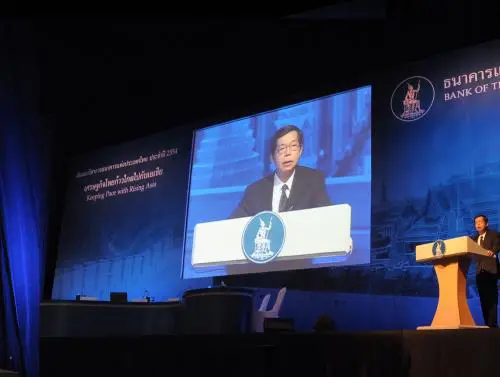


Bank of Thailand Governor Prasarn Trairatvorakul says the Monetary Policy Committee (MPC) stands ready to call a special meeting if necessary to assess the economic situation amid the country's worst flooding in years.
The central bank is likely to lower its estimate for this year’s economic growth by more than 1 percentage point from its July forecast because of the floods and the US and European economic problems in the third quarter, he told a BOT symposium on “Keeping Pace with Rising Asia” yesterday.
In July, the central bank projected growth in gross domestic product at 4.1 per cent. The next revision is scheduled for next Friday.
The BOT has given a preliminary estimate for the flood loss to manufacturing of about Bt100 billion, as output is expected to drop this quarter and some of next quarter.
“A contraction is possible in the fourth quarter. However, the economy is expected to see positive growth for the whole year,” Prasarn said.
The risk to growth has become graver and the MPC on Wednesday paused its rate rises to assess the post-flood situation, as inflationary pressure was still evident. The policy rate remains at 3.50 per cent.
Since foreign investors might think about moving their business out of Thailand, authorities should limit the flood damage geographically and reassure investors and the capital market that the situation was manageable.
Flood-hit Ayutthaya and Pathum Thani account for about 17 per cent of total production in Thailand.
“If the damage is confined and other industrial areas are not flooded, we can explain [to investors] that other sites are not inundated and they can locate there.
In the swamped areas, explanations on [flood crisis] management should be done to boost confidence,” he said. The BOT has coordinated with local and foreign banks as well as specialised financial institutions to ensure ample liquidity in the financial system.
The government’s pledged projects should be re-prioritised to show fiscal discipline. If there is a large need for borrowing, the funds should be clearly restricted to investment in flood prevention. That will help money markets understand the situation, he said.
Meanwhile, Fitch Ratings (Thailand) has said that although the severe flooding in Central provinces will affect economic growth in the current fourth quarter, the direct impact on companies rated by Fitch should be limited to two companies with operational sites in the affected area. Nevertheless, there is no immediate rating impact on these companies.
The production plants of SVI (rated “BBB+(tha)”/stable) are in Bangkadi Industrial Estate, which is at risk of flooding. While SVI has insurance for property damage and business interruption, the impact on its operations and financial position could be material.
The golf course and rice-packaging facilities of MBK (rated “A-(tha)”/stable) could also be flooded, though these are small contributors to MBK’s overall operating cash flows.
Fitch maintains coverage of 22 corporates in Thailand.
