
Thai firm plans JV for Burma wind-power projects


Play
Gunkul Engineering may join with the Electricity Generating Authority of Thailand (Egat), the Provincial Electricity Authority (PEA), and foreign investors in a joint venture to develop its wind-power project in Burma worth Bt60 billion.
The company last month signed a memorandum of understanding with Burma’s government for the project with a capacity of 1,000 megawatts for export to Thailand.
Gunkul filed to the Stock Exchange of Thailand yesterday clarifying the signing of the MoU as reported by international media at the end of last month. In the filing to the SET, Gunkul said the MoU signing was for a feasibility study on the development of wind-power plants in Burma. It is not a commercial agreement. If there are any further updates on the status of the feasibility study for the development of the project, the company wo;; provide the information later.
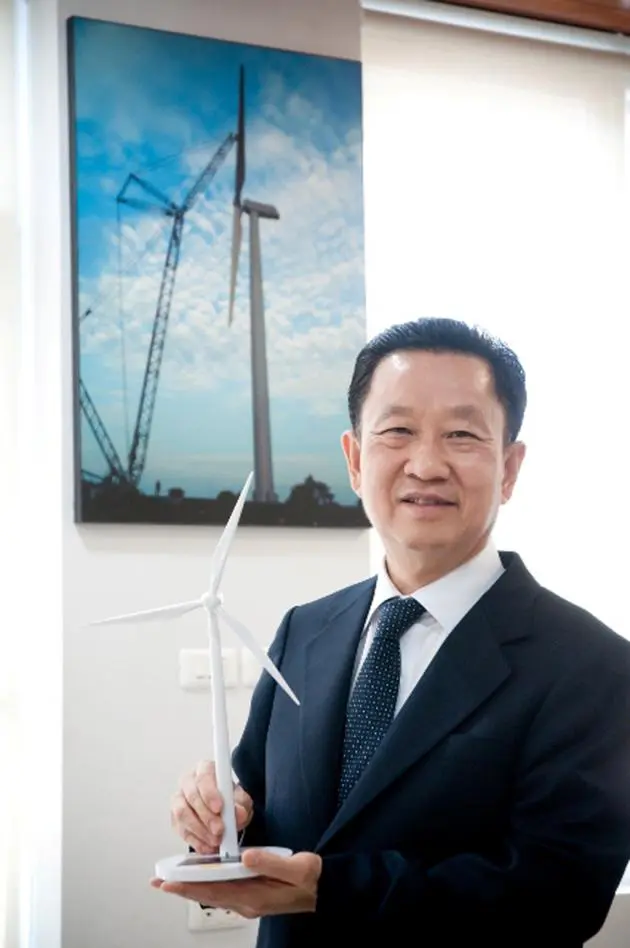
The company’s executive chairman, Gunkul Dhumrongpiyawut, said the project with a 30-year concession term would be divided into five phases with 200MW capacity each.
The plants will be located in three states in the southeast of Burma – Mon, Kayin and Tanintharyi. It will begin the project development in Tanintharyi first, at an estimated cost of not more than Bt100 million in the first year.
The company will conduct a feasibility study for six months after the signing of the MoU and take another six months to install the wind turbines to measure the wind currents. The statistics will be collected for one year before beginning plant construction. The project is expected to produce electricity within three years.
The company will set up a joint venture to carry out the project, in which it intends to own between 10 and 20 per cent, while Burma’s government will own 10 per cent. It will woo possible partners to hold the rest of the shares.
He added that Egat and the PEA were interested in the project and the company would allow both to own not more than a combined 25 per cent in the joint venture. It will also court foreign investors such as South Korea and Japan to pick up the rest.
Gunkul will also seek loans from local and foreign financial institutions such as the Asian Development Bank and World Bank to fund the project. He expects the whole project would be completed in 2013 and will begin to realise revenue in 2015.
He said Burma had given this deal to Gunkul because the company has had trade relations with the country for 15 years. In the process, it has gained the trust of the government.
Meanwhile, the company’s managing director Sopacha Dhumrongpiyawut said Gunkul’s subsidiary G-Power Source Co, which has invested in a solar power plant in Thailand, is seeking a Thai partner out of three potential partners to invest jointly in the project. The company is expected to announce its partner’s name on December 20. All three prospective partners are listed in the SET.
G-Power has invested in the Bt3-billion solar-power plant with 26MW capacity. It is expected to start selling electricity in February and start realising revenue in the first quarter of next year.
Gunkul has projected total revenue next year of about Bt4 billion. This does not include revenue realisation from backlog contracts in Burma worth more thanBt1.5 billion. This year it expects revenue of Bt3.5 billion, of which Bt1.3 billion is expected to come from its business in Burma. In the third quarter, it earned revenue of Bt2.6 billion, of which Bt1.1 billion was contributed by operations in Burma.
Next year, Gunkul will focus on selling oil and gas products and services in Burma, besides power systems, fresh air-conditioning systems, and renewable energy, according to Zeya Thura Mon, managing director and chief executive officer of Zeya & Associates, the sales representative office of Gunkul in Burma.
It expects sales revenue of US$100 million (Bt3 billion) next year in Burma against $57.55 million as of October this year. The company’s revenue last year was $19.63 million, up from $8.53 million a year earlier.
