
SET outlook dim for Q1 2012
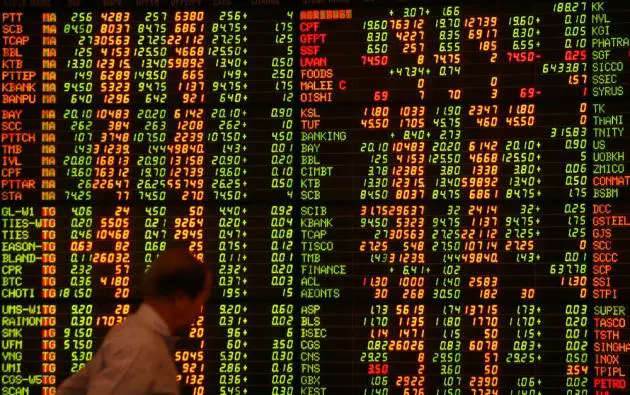


The Stock Exchange of Thailand finished the year in a lacklustre mood, with the composite index ending below last year's level. The situation does not look bright for early in the new year either, because of selling pressure from unit-holders of long-ter
The year 2011 marked the first time since the Lehman Brothers crisis that the SET has seen foreign net selling. Foreign investors sold Bt5.6 billion more shares than they purchased.
The SET Index yesterday ended the year at 1,025.32 points, down 0.72 per cent from last year’s closing of 1,032.76. Turnover yesterday was the lowest in years, at Bt8 billion, against a daily average in 2011 of nearly Bt30 billion.
In 2008, trading by foreign investors showed net selling of Bt162.34 billion, due mainly to the financial crisis. Foreigners’ trading volume brightened considerably in 2009 and 2010, showing net buying of Bt38.23 billion and Bt81.72 billion respectively.
Asia Plus Securities said in a research note that despite positive sentiment from US stock markets on the last trading day of the year, LTFs worth a combined Bt22.9 billion are due to be sold in 2012, which will pressure trading sentiment on the SET during the early part of the year. Investors are urged to reduce their holdings temporarily and wait for the new round of trading.
For the past three years, the SET Index has risen by about 3 per cent on the first two days of the year. In 2008 – the first year of this batch of LTFs – the composite index was at 577 points. Sellers of these LTFs will enjoy tax benefits. From 2008 to 2010, about 50 per cent of the accumulated purchases of these LTFs were sold, causing the SET to fall by 4.38 per cent on average.
“Investors who bought LTFs since 2008 will gain a return of 78.8 per cent, excluding the tax benefit. The high return will encourage LTF holders to sell at least Bt11.4 billion worth of investments in January,” Asia Plus Securities said.
The securities company said the uncertain global economy, particularly the situations in the United States and Europe, would be the main factor determining fund flows in 2012. Hence the market is expected to be volatile during the first quarter, as Europe seeks solutions to its debt crisis.
In 2011, foreign investors were net sellers in Asian stock markets to the tune of US$13.877 billion (Bt437.8 billion), equivalent to 39 per cent of the net buy level seen in 2010. The Taiwanese market saw net selling of $9.246 billion, equal to 97 per cent of 2010’s net buying of $9.577 billion. South Korea’s stock market recorded net selling of $8.583 billion, equivalent to 43 per cent of net buying in 2010, whereas the Thai bourse showed net selling of $184 million, or about 7 per cent of the net buying activity seen in 2010.
An analyst at Tisco Securities said stock markets globally would not see a “January effect”, which usually sees prices increase, as investors remain concerned about a possible technical recession in the euro zone in the first quarter of 2012. Meanwhile, banks in Europe are required to submit their plans for increasing capital to €115 billion (Bt4.7 trillion).
The analyst said the selling of five-year LTFs, worth an expected Bt10 billion, would pressure the SET in the first week of the year. As a result, the composite index is not expected to achieve 1,042-1,050 points, and could fall below 1,000 or even 950 points in the final week of January. There is only a 10-per-cent chance that foreign investors will be net buyers in the Thai stock market, the analyst said.
Bualuang Securities said in its research that SET trading in the first half of the year would be sideways down, while a recovery would occur in the second half. The Thai economic outlook for 2012 remains uncertain because of many risk factors such as weak profit caused by the flooding, and the debt crisis in Europe.
