
Move to high-end markets eases flood impact


Play
Businesses drop cheap-goods strategy, bank on new plan to ensure growth amid increasingly tough competition
Despite the disruption to manufacturing caused by the flooding in late 2011, Thai exporters remain optimistic about sales, as they have eschewed a cheap-goods strategy in favour of shipping premium products.
As an export-oriented country, the strategy will ensure Thailand continues to grow amid tougher competition and rising production costs.
The serious flooding late last year prompted concerns among exporters that growth would suffer, and there remain fears that Thailand will miss its 2012 export target if the government does not prepare thoroughly and launch a concrete disaster-mitigation plan.
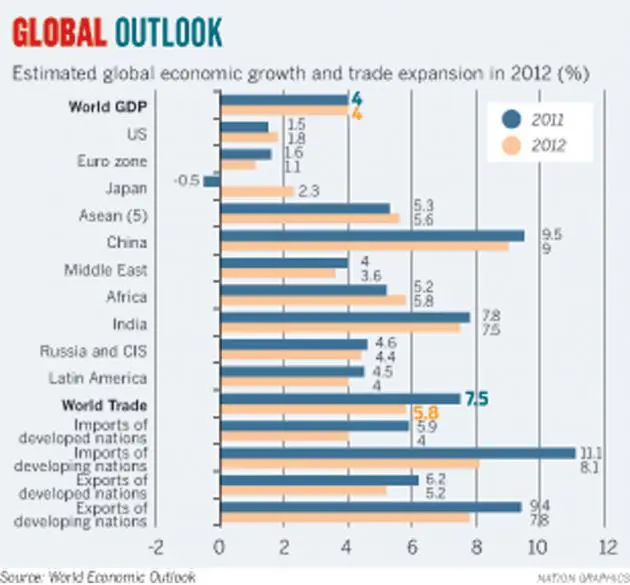
But the country’s export target for 2012 is still expected to grow by 15 per cent to US$258 billion (Bt8.2 trillion) from Bt224 billion last year. This is based on a forecast of global economic growth of 4 per cent in 2012 – unchanged from 2011. However, global trade growth will fall from 7.5 per cent in 2011 to 5.8 per cent in 2012.
Slowing economic growth in the euro zone, China, the Middle East and Russia will dampen global trade, but an expected strengthening of economic expansion in the United States and Japan, along with stronger growth in Asean – especially Indonesia – will be positive factors.
The Export Promotion Department has assumed that the Dubai oil price will average $105 per barrel this year, while the exchange rate will be stable at an average of Bt30-Bt31 against the greenback, from the 2011 average of Bt30.3.
Nuntawan Sakuntanaga, director-general of the Department of Export Promotion, said the department will continue to search for business opportunities in new markets, mainly in Asean, China, India, the Middle East, Africa and Latin America, which have expanded rapidly compared with traditional markets like the EU, the US and Japan.
The department will emphasise the promotion of higher value-added products in all sectors, since Thailand can no longer rely on low-cost, labour-intensive production following the government’s policy to raise the daily minimum wage by 40 per cent in April. It will also focus more on developing small and medium-sized enterprises (SMEs) and encouraging exporters to reap greater benefits from free-trade agreements.
In an attempt to quickly accelerate trade, the department has also arranged more than 100 activities overseas. These include trade fairs both abroad and in Thailand, business-matching services between importers and exporters, the launch of Thai exhibitions in a variety of sectors and the promotion of Thai products and brand names within international markets.
Thai exporters in various sectors have also agreed that they must focus more on promoting higher value-added products, mainly designer goods and premium goods, to increase export opportunities in emerging markets and preserve the Kingdom’s share of traditional markets, where consumers are becoming increasingly concerned about health and value-added products.
Industries that foresee similar strategies to boost sales are food, jewellery, life-style goods and toys. They said they would develop their strengths to focus more on value-creation, innovation and promoting the right markets.
On the other hand, the garment, furniture and footwear sectors are pessimistic, expecting flat growth in 2012 due to tough competition and higher production costs.
Although they said they would face zero growth in exports from Thailand, their facilities in other countries would see exports grow; many have shifted to invest in other countries in Asean as a strategy to reduce costs as production gets more expensive here.
Garments
The industry is expected to see flat growth in 2012 due to lower production capacity in Thailand, while large-scale manufacturers have set up plants in other Asean countries, mainly Vietnam, Cambodia and Laos. Burma will also be a new potential market for the industry in the next few years, due the opening up of the economy by the government there.
Sukij Kongpiyacharn, president of the Thai Garment Manufacturers Association, said the sector will continue to face flat growth in 2012 as many producers have shifted outside Thailand to take advantage of lower labour costs.
The value of exports in 2012 will remain unchanged at $3.2 billion. However, Thailand will still be the regional hub for garment trading and design as it has a long history of development, while local enterprises have strong supply chains here.
Gems and jewellery
Next year’s exports are expected to grow by 10 per cent from 2011’s expected valued of $12 billion.
“Stronger growth in India and China will continue to drive the growth of the industry,” said Vichai Assarasakorn, former president of the Thai Gems and Jewellery Traders Association.
He added that though exporters rely mainly on traditional markets like the US and the EU, economic slowdowns in those countries have not had a big impact on gem and jewellery sales, as these products focus on the high-end market.
To boost sales, Thai producers will try to penetrate more new emerging countries and focus on new designs to ensure competitiveness.
However, Vichai voiced concern that higher wages in the country will destroy some SMEs, since they have low financial liquidity.
Although the industry has paid labourers higher than the minimum wage, some SMEs will face difficulty staying in business, he noted.
Toys
Toy exports in 2011 did badly due to the floods, which temporarily suspended production at many large toy producers in seven industrial estates. Exports in 2011 are expected to drop by 10 per cent to $200 million. However, exports this year are expected to recover and experience a 10-per-cent expansion.
“The manufacturing of toys will recover as producers have focused more on value-added in order to increase competitiveness with goods from China.
“Quality development and a focus on educational toys will be the keys to boosting exports to many countries,” said Thai Toy Industry Association president Duangjai Koosrivinij.
Indonesia and India, which have experienced strong economic expansion due to their growing middle classes, will be major destinations for toy exports in 2012, she said.
Processed foods and farm goods
The industry is expected to grow by about 10 per cent in 2012; the major drivers are canned foods and processed seafood.
Paiboon Ponsuwanna, chairman of the Thai National Shippers Association, said processed seafood, in particular tuna, would be a standout product for Thai food exporters next year.
He said that although consumers in major markets including the US and the EU may switch to cheaper goods, rising demand in high-growth countries, including India and nations in the Middle East, will boost exports of processed foods.
Thai exporters will also focus on more value-added, rather than traditional commodities, which create less income.
