
Thai army disputes Cambodia’s displacement claims at UN
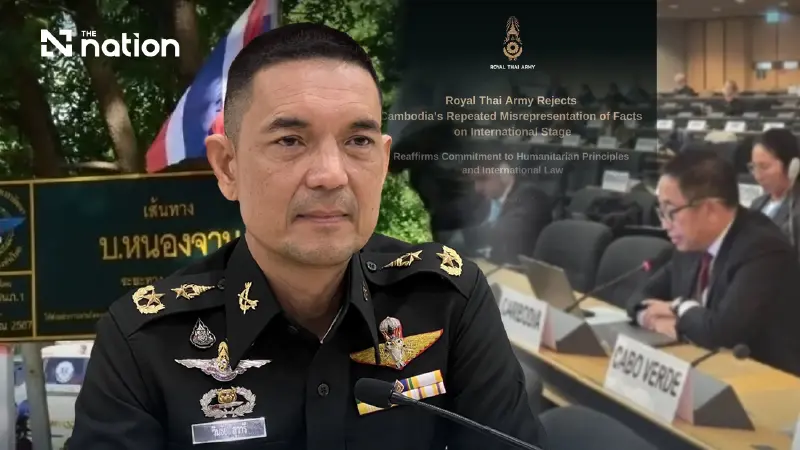


Thai army rejects Cambodia’s portrayal of 650,000 displaced people and disputes claims over border areas and civilian returns.
The Royal Thai Army has challenged Cambodia’s account of displacement following last year’s border fighting, saying figures presented at a United Nations meeting risk creating a misleading picture of the current situation.
Maj Gen Winthai Suvaree, spokesperson for the Royal Thai Army, responded on October 15 to remarks by Cambodian Ambassador Sovann Ke at a meeting in Geneva two days earlier.
Sovann, Cambodia’s Ambassador and Permanent Representative to the United Nations Office in Geneva, told the 77th Session of the Executive Committee of the UN High Commissioner for Refugees that about 650,000 Cambodians had been displaced at the height of the December 2025 fighting and that more than 20,000 remained unable to return home.
Cambodia also accused Thailand of occupying Cambodian territory, obstructing civilians from returning to their communities and damaging homes and infrastructure. Cambodia’s Interior Ministry separately reported that about 649,000 people had been displaced at the peak of the conflict, with around 625,000 having since returned.
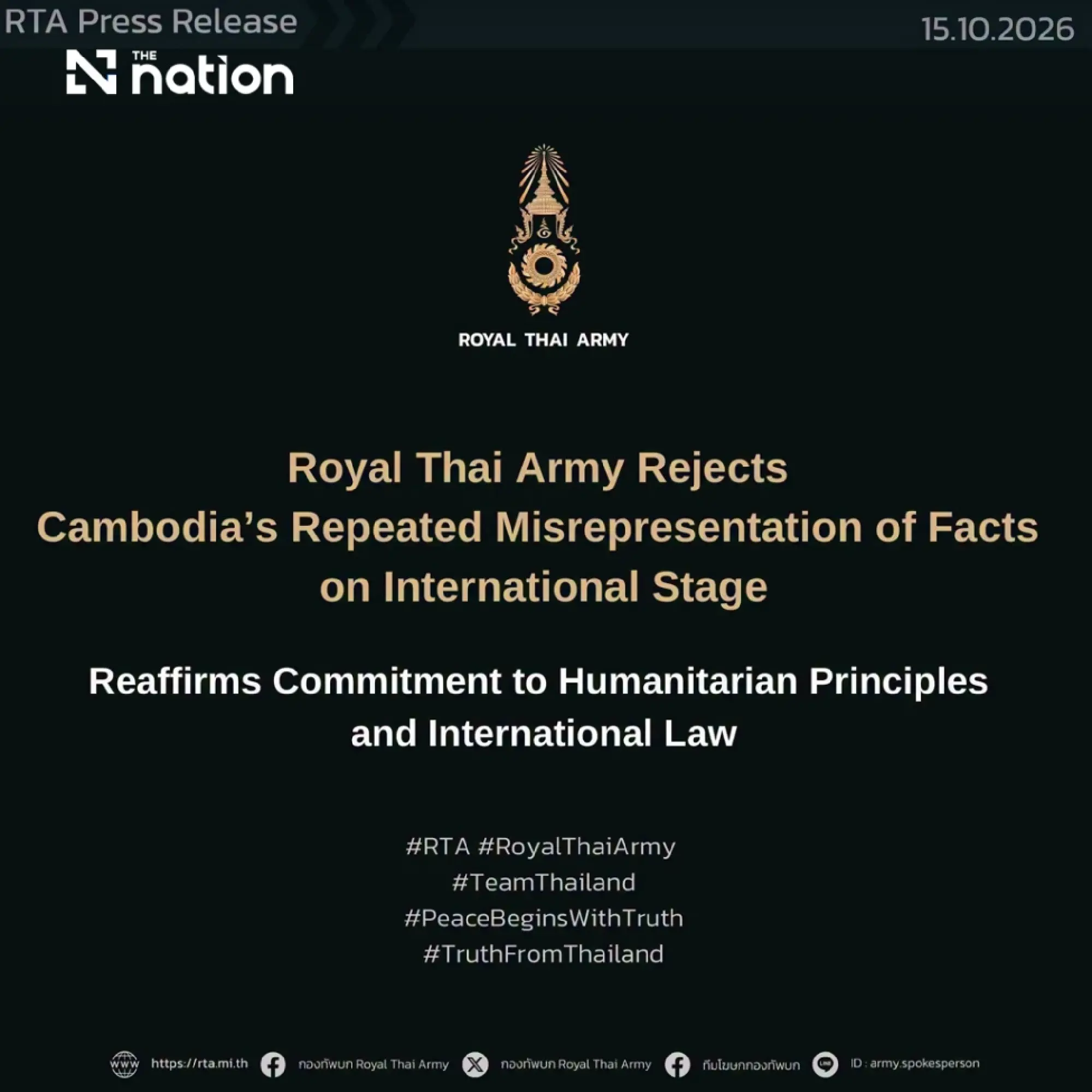

Army challenges interpretation of 650,000 figure
Winthai said the 650,000 figure represented people who had temporarily moved into shelters to escape fighting rather than the number still unable to return home.
He compared the situation with Thailand, where nearly 500,000 people were evacuated during the fighting before most returned after the December 27 ceasefire.
The ceasefire took effect at noon on December 27, 2025, under a joint statement agreed at a special meeting of the Thailand-Cambodia General Border Committee. The agreement provided for civilians in border areas to return safely once the situation stabilised.
Winthai also disputed Cambodia’s assertion that more than 20,000 people remained unable to return because of Thai actions.
He said Thai authorities had examined three areas in Sa Kaeo province — Ban Nong Chan, Ban Nong Ya Kaeo and Ban Khlong Phaeng — and identified about 4,600 people, comprising more than 900 households, as being connected with the communities in question.
That figure relates specifically to the three areas cited by Thailand and is not directly equivalent to Cambodia’s nationwide estimate of people who remain displaced.
Sovereignty claims remain disputed
The Thai army maintains that Ban Nong Chan, Ban Nong Ya Kaeo and Ban Khlong Phaeng are within Thai sovereign territory.
Winthai said Cambodian communities had expanded into the areas over more than four decades, dating from a period when Thailand allowed Cambodian refugees fleeing internal conflict to take temporary shelter on humanitarian grounds.
Cambodia disputes Thailand’s territorial position and has accused Thai forces of occupying Cambodian land.
Thailand has previously maintained that the three locations are under Thai sovereignty and that its operations there are intended to restore security and prevent further threats rather than seize Cambodian territory.
Winthai said the longstanding settlement issue should be treated separately from displacement directly caused by the December fighting to avoid conflating two different disputes.
Thailand has sought to address land-boundary issues through bilateral mechanisms under the 2000 Memorandum of Understanding on the Survey and Demarcation of Land Boundary, commonly referred to in Thailand as MOU 43.
The agreement established the Joint Boundary Commission as the main bilateral mechanism for surveying and demarcating the land boundary.
Thailand rejects occupation allegation
Responding to Cambodia’s allegation that Thai forces had occupied Cambodian territory, Winthai reiterated the army’s position that several of the areas cited by Cambodia lie within Thailand.
He said some locations had also been used to launch attacks against Thai soldiers and civilians during the fighting, making continued security controls and surveillance necessary to prevent further attacks.
The measures were intended to protect Thailand’s sovereignty, troops and civilians while taking humanitarian considerations into account, he said.
These remain competing territorial claims between the two countries and have not been resolved simply by either side asserting sovereignty.
Army calls for disputes to return to bilateral mechanisms
Cambodia has called on Thailand to comply with agreements reached on October 26 and December 27, 2025 and with international law.
The October 26 joint declaration signed in Kuala Lumpur committed both governments to the peaceful settlement of disputes, respect for sovereignty and territorial integrity, military de-escalation and measures to reduce inflammatory or false information.
Winthai said Thailand remained committed to peaceful settlement through existing bilateral mechanisms and the agreements already reached by the two sides.
He called for both countries to implement the agreements seriously, respect each other’s sovereignty and territorial integrity and base efforts to resolve the dispute on verifiable facts.
The army spokesperson also accused Cambodia of repeatedly presenting what Thailand regards as inaccurate information on international platforms, arguing that such exchanges could undermine conditions for bilateral negotiations.
He urged Cambodia to focus on humanitarian assistance for affected civilians and to pursue outstanding disputes through established dialogue mechanisms.
