
Thai fortunes tied to key economies


Play
The Asia-Pacific, including Thailand, remains vulnerable to an economic slowdown despite strong trade links within the region, a report from the Mumbai-based subsidiary of Standard & Poor's showed.
“Although the higher trade interaction within the Asia-Pacific region provides some intermittent buffer, the eventual trade exposure of China, South Korea, Japan and the five countries that form Asean-5 – Indonesia, Malaysia, the Philippines, Thailand, and Vietnam – with the advanced economies remains high,” Crisil Limited’s report on “Growing Global Risks Eclipse Asia-Pacific Economic Growth in 2012” said.
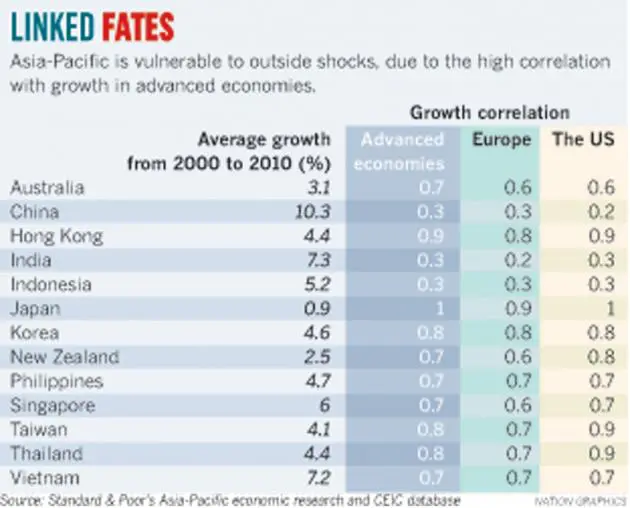
The extent of vulnerability differs across countries. Among Asean-5 economies, correlation with growth in the advanced economies is highest for Thailand (0.8), meaning that the country depends largely on advanced economies.
Thailand’s association with growth in the euro zone and the United States are also high at 0.7 and 0.9, respectively, translating into high vulnerability to possible European and US shocks.
Economic growth in Asia-Pacific could fall sharply in 2012, in line with lower growth forecasts for the US and a mild recession in the euro zone, the Crisil report said.
“We expect GDP [gross domestic product] growth rates in 10 out of the 14 Asia-Pacific economies to fall in 2012,” the report said.
However, Thailand is expected to record higher economic growth at 3.5-4.0 per cent in 2012 due to rehabilitation activity after the nation’s worst floods in decades. The country’s GDP growth is estimated at 2.6-3.1 per cent in 2011.
Inflation forecasts for 2012 have also been revised sharply downward for all Asia-Pacific economies on the back of the global slowdown and some respite from global commodity prices, the Crisil report said. However, upside risks to the inflation forecast arise from continued depreciation of currencies, which could keep imported inflation at elevated levels.
The Crisil report said the risks to forecasts are higher and rising on the downside.
“A prolonged period of euro zone recession or an unexpected global shock could yield much lower growth and inflation in 2012,” it said.
