
NBTC questioned over re-farming criteria


The National Broadcasting and Telecommunications Commission is urged to better clarify the reasons behind the proposed re-farming periods, or more lawsuits could emerge after the implementation of the telecom master plan, said an academic.
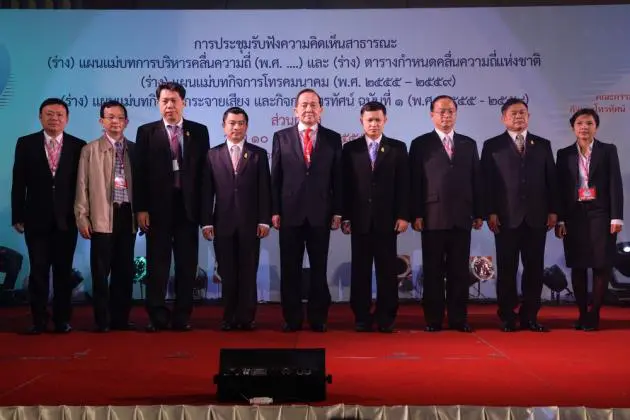
NBTC on Friday hosted the public hearing on the draft Spectrum Management Master Plan, Telecommunications Master Plan, and Broadcasting Master Plan.
Telecom academic Anuparp Thiralarp said that re-farming periods are the core of the draft telecom master plan. He said that the NBTC's criteria is not clear enough why all radio frequencies must be returned to the commission for re-distribution in five years, 10 years in the case of television frequencies and 15 years for telecom frequencies.
"The NBTC's reasoning is poorly supported. Specifying the periods in this manner would lead to defiance from operators. Eventually, lawsuits are expected. As such, thorough guidelines should be set for the public hearing," he said.
He also commented that the master plans just contain preliminary action plans, without details of benefits to the country's competitiveness.
Thailand Development Research Institute's Somkiat Tangkitvanich also said that more details should be included in the master plan. For example, for the 2.1 GHz spectrum licensing, more than three operators should be allowed to join the bid as three licenses can be issued. He also said that to draw foreign investment, NBTC should also make it clear in the investment manual that all bidders would not be subjected to the Foreign Business Act.
The following are summary of the draft master plans.
1. Draft Spectrum Management Master Plan
The draft Spectrum Management Master Plan aims for efficient spectrum management for the utmost public benefit in all national, regional and local levels, taking into account free and fair competition, and universal distribution of spectrum for education, culture, state security, and other public interests.
The draft Spectrum Management Master Plan consists of 6 strategies as follows:
Strategy 1: Managing Spectrum at International Level
1.1 fostering international cooperation in spectrum management while maintaining public interest of the country
1.2 coordinating spectrum management matters in order to prevent and resolve problems at international level
1.3 coordinating with international regulators and satellite operators
Strategy 2: Spectrum Refarming
Spectrum refarming with the puspose for re-assigning or improving spectrum utilization is categorized as follows:
2.1 Government agencies and state enterprises, who allow the use of assigned spectrum by other party by means of legitimate permission, concession or contract;
2.2 Legitimate spectrum licensees with clearly specified period of use
2.3 Legitimate spectrum licensees with unspecified period of use
Strategy 3: Spectrum for National Security
Developing appropriate mechanism in collaboration with national security agencies in order to manage and utilize spectrum necessary for national security
Strategy 4: Spectrum for Disaster Relief and Prevention
Assigning spectrum and prescribe licensing criteria for using such spectrum for disaster relief and prevention, emergency and natural calamity, as well as for other public benefits
Strategy 5: Digital Switchover
Preparing a digital switchover transition plan, with digital television broadcasting switch-on within 4 years and analog switch-off within a specified timeframe
Strategy 6: Broadcasting Spectrum for the General Public
6.1 Prescribing licensing criteria in order to allow the general public to have access to available broadcasting spectrum
6.2 Assigning broadcasting spectrum to allow the general public for temporary use during transition period prior to digital switchover
2. Draft Broadcasting Master Plan
The first-ever 5-year draft Broadcasting Master Plan focuses on the following 3 basic principles laid down in the Act on Organization to Assign Radio Frequency and to Regulate the Broadcasting and Telecommunications Services B.E. 2553 (2010):
1. Development and promotion of fair competition;
2. Spectrum and business licensing, focusing on efficient spectrum management for all types of services;
3. Enabling the general public to use spectrum for community services in a proportion of not less than 20 per cent of the spectrum assigned in each licensing area.
The draft Broadcasting Master Plan consists of 7 strategies as follows:
Strategy 1: Spectrum and broadcasting business licensing to be available for all types of services with efficient use of spectrum in each licensing area.
Strategy 2: Regulating broadcasting business for socio-economic benefit and national security, by utilizing appropriate spectrum and equipment while encouraging free competition under transparent and fair rules.
Strategy 3: Protecting consumer from being inappropriately exploited by broadcasters, by prescribing criteria for consumer protection, setting up a mechanism for convenient, efficient, timely and non-discriminatory complaint handling, and enabling strong-willed and self-informed consumers who are able to access, communicate, and use media efficiently for their own benefit
Strategy 4: Promoting consumers’ rights and freedom to communicate, by promoting equal and universal access to information without any intervention from broadcasters to prevent dissemination of news and information or expression of opinions, or to impede or obstruct consumers’ rights and freedom to receive information from various sources.
Strategy 5: Improving quality of broadcasters including human resource, programming, and overall business operations, in response to the provisions under relevant Acts.
Strategy 6: Promoting digital switchover in order to encourage efficient spectrum utilization, and to ensure access by the general public to have access to broadcasting spectrum for a proportion of not less than 20 per cent of the spectrum assigned by means of spectrum licensing for digital television broadcasting and universal reception of such digital transmission.
Strategy 7: Developing organizational management system geared towards efficient regulator, by using the concepts of systematic management, efficiency, good governance, professionalism, and acceptance by stakeholders.
3. Draft Telecommunications Master Plan
The draft Telecommunications Master Plan provides direction for the development of telecommunications business in the next 5 years by aiming to provide the general public with wide variety and good quality of telecommunications services via modernized telecommunication networks in an affordable price, based on fair competition and efficient resource management. It also provides for networks as essential infrastructure for national development towards knowledge-based and innovative society, in order to raise competition profile and to reduce disparity between city and rural residents.
The draft Telecommunications Master Plan consists of 7 strategies as follows:
Strategy 1: Developing and promoting free and fair competition, by regulating telecommunication business in all levels where monopoly, reduction or restriction of competition exist, in order that the general public is able to access telecommunications service in an affordable manner.
Strategy 2: Spectrum Licensing and Telecommunications Business Licensing, by granting licenses to new entrants based on free and fair competition, and promoting licensing for new technologies, through technology-neutral doctrine, under the basis of fostering competition and promoting accessibility to telecommunication and broadband services.
Strategy 3: Utilizing efficient telecommunication resources, by aiming to allocate and license telecommunication resources in an efficient manner, to promote infrastructure and resource sharing as far as practicable with a view to achieving maximum benefit and in compliance with international norms.
Strategy 4: Providing universal basic telecommunications service, by aiming to create measures for motivating operators to provide universal basic telecommunications services in targeted areas and to targeted underprivileged groups, in order to improve quality of life and social development; and also specific measures for raising potentials of manufacturers of telecommunication equipment intended for the disables and the underprivileged.
Strategy 5: Protecting consumers, by promoting consumers’ awareness in basic rights in telecommunications services, increasing consumers’ capabilities in keeping pace with the changing technologies so as to enable them to use it efficiently, as well as establishing measures for increasing ethical roles and social responsibilities of the operators.
Strategy 6: Readiness preparing for the Implementation of the ASEAN Economic Community and other international cooperation, by fostering cooperation in telecommunications, creating networking mechanism in infrastructure, regulations, industry, R&D entities, regulators and the general public, as well as promoting international cooperation in both bilateral and multilateral levels.
