
Leadership development among top priorities


Play
More than 58 per cent of employers plan to hire more staff
Well-regarded management expert Peter Drucker’s famous quote “people join the organisation but leave their boss” is still obviously relevant to Thai businesses, which are feeling the heat to develop the leadership capabilities of their “bosses” as an effective way to retain their staff.
This was evident in a survey conducted by Orchid Slingshot Research Centre.
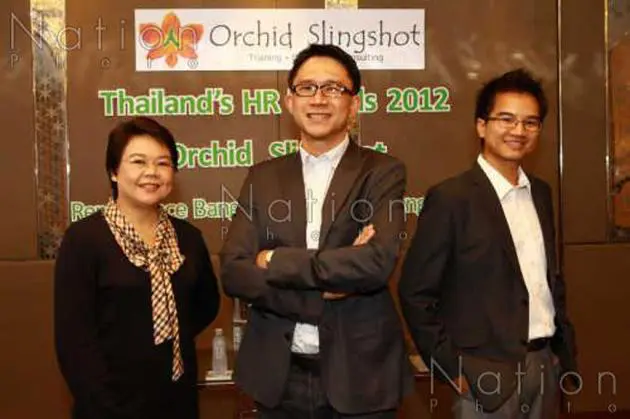
Senior executives, human resources and other division executives of 187 Thailand-based organisations took part in the survey. They cited leadership development, talent management, and employee engagement as their top HR management priorities in 2012. They identified them as among the key areas where they find huge room for improvement, said Dr Wanida Phondej, head of the newly formed research unit of Orchid Slingshot, a training, coaching, and consulting firm.
The results of Orchid Slingshot’s Thailand survey is in line with a global research revealed earlier this month by Deloitte Consulting which also showed “leadership shortages and succession”, “recruiting hard-to-find skill sets” and “sustaining employee engagement and morale” as topping the agenda of most large-sized corporations.
Apiwut Pimolsaengsuriya, chief executive officer of Orchid Slingshot, said the survey results showed that organisations have highlighted the importance they give to developing leaders at every level, who are recognised for their crucial contribution towards retain talents and engaging employees.
“Organisations pinpoint leadership development as a key element for staff retention. They have recognised the fact that ‘people join the organisation but leave their boss’ as Peter Drucker has said.
“This is because most bosses are promoted for being good at their jobs, not necessarily in people management,” said Apiwut.
Following the top three priorities, the participating organisations also pointed out “HR as strategic partner”, “recruitment and selection”, “retention strategy”, and “performance management”, as their top HR focuses this year. Surprisingly, “globalisation and free-trade area” and “labour cost management” were low priorities of the 21 HR topics provided in the questionnaire, despite the upcoming Asean Economic Community in 2015 and the sharp adjustment of nationwide minimum wage to Bt300 daily and Bt15,000 a month for bachelor’s degree holders from April.
“Despite the upcoming AEC, there are not many organisations that are vigilant. It’s not even on the top 10 [of their HR priorities]. This is worrisome,” he said.
Apiwut said the surprising attitude towards labour-cost management, might stem from the fact that labour costs are not a major issue for the participating organisations, which give more importance to leadership management.
The Orchid survey points to a positive news for employees seeking jobs: 58 per cent of organisations are planning to recruit more workers this year; 27 per cent plan no change, and 14 per cent plan to cut staff. About 14 per cent of respondents said they expected recruitment and the efforts to close the skill gap to be “very difficult” while 78 per cent said “somewhat difficult”.
Despite some cautious observations on the economic outlook following the historic floods that hit many Thai businesses and households late last year, Apiwut said the Thai economy seemed to have kickstarted well in 2012 as his firm had witnessed an “amazing” amount of work and interest from customers looking to train their workers, and for business consultancy.
In filling up their top executive positions, 61 per cent of respondents in the survey say they will “promote from within” while the rest say they will look to recruit from outside their organisations. The percentage of grooming from within is higher for lower-position jobs.
“For higher positions, they look from outside. This may partly stem from the fact that they can’t grow their staff fast enough [to fill the succession gap], and also from a belief that they need to seek people from outside to stir a change [in the organisation],” said the Orchid CEO.
Staff turnover rate is the most important metric that participating organisations use for measuring their HR effectiveness (87 per cent), followed by employee satisfaction (80 per cent), and employee engagement (78 per cent), and absence rate which gets a 73-per-cent score.
“Interestingly, organisations give more importance to training hours than measuring the ROIs [return on investments] from these expenditures. This implies that organisations realise human resource development is a long-term investment, which is not easy to measure in figures,” said Wachirapun Chotechuong, an Orchid consultant, commenting on the survey.
The survey showed that the capability to “work from anywhere” tops the focus of organisations looking to make use of technologies for HR management according to 70 per cent of respondents, followed by Internet-based system for HR application (68 per cent), self-service application (67 per cent), e-learning (66 per cent), and social network for recruiting (64 per cent).
Thun Thamrongnawasawat, Orchid’s consulting partner, said the so-called “social learning”, which included webinars, CEO blogs, podcasts, forums, twitter, and “crowd-sourcing” is a new trend in HR development and was recently added by the American Society of Training and Development as one of the leadership development competencies. Adapting to this rapid change, Orchid recently founded a new joint venture – Big Tree Synergy – with Source Learning, an e-learning firm, to develop an “HR digital platform” for serving Thai clients.
The consultancy is also introducing a new curriculum to help organisations develop the emotional intelligence of their leaders, he said.
