
Egg price controls failing to achieve objectives, 'Nation' survey finds


Play
The government's price-control measures for eggs are not only ineffective in terms of curbing the cost of living but also harm egg farmers, with retail prices in the market being quoted above ceiling levels, a survey by The Nation found yesterday.
Meanwhile, hen-egg farmers continue to face losses due to the rising cost of feed meal.
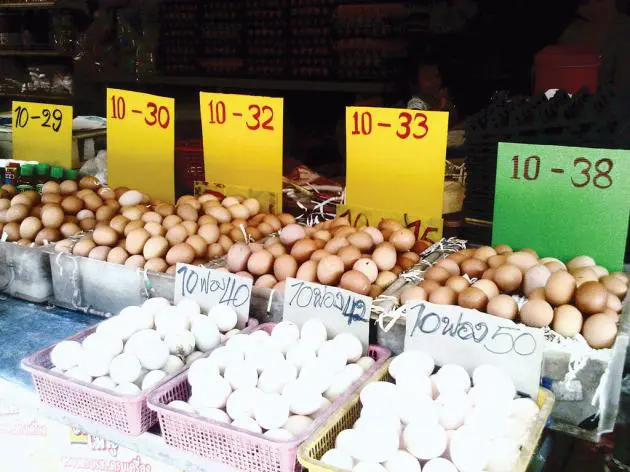
The survey found that the retail price of eggs traded in the market is higher than the Commerce Ministry’s price recommendation by an average of 30 satang to Bt1.30 per egg.
The ministry has set a retail ceiling of Bt2.40 to Bt3, depending on the size. The ceiling for the smallest size of egg (No 5) is Bt2.40, rising by 10 satang for larger sizes from No 4 through to No 0, which is the biggest grade.
However, the survey found that the actual price for consumers ranges from Bt2.70 for the smallest size to Bt4.50 for the largest.
An egg retailer in Sanambinnam market, Nonthaburi, said she was unable to quote prices in accordance with the government’s ceiling because wholesale prices were already higher than the recommended prices.
“The government has inefficiently set up retail prices, as the prices do not reflect real cost of production. It should carefully consider egg prices to ensure a fair return for farmers, traders and consumers,” said the trader.
Egg traders at a weekend market in Samut Prakan said prices had been going up due to reduced supply since the flood devastation late last year. It will take months to breed new hens after farmers’ stocks perished during the flooding.
The most important factor coming down the line from farmers is an increase in production costs, particularly for feed meal, the traders said.
Boonyong Sritrirasri, chairman of the Egg Farmers Cooperative in Chon Buri, said the government’s price ceiling did not reflect the real costs of hen-egg farmers.
The current control price for mixed eggs is Bt2.20, but the average production cost has increased to Bt2.60-Bt2.70 due to rising input costs, in particular for feed meal, the price of which has been hiked by 20 satang per kilogram, he said.
The ineffective price-control measure has encouraged wholesalers to pressure farmers to sell eggs at a low price of Bt2.40, which has created losses for farmers, he added.
He called for the government to increase the retail price to Bt3 in order to reflect the actual cost of production. Otherwise, if it continued to control prices at the current level, farmers would seriously cut down the number of layer hens, which would create a shortage of eggs in the near future.
Moreover, Boonyong said the government’s plan to help supply low-price feed meal for farmers had not yet materialised in any provinces.
Manoch Chutubtim, president of the Hen-Egg Farmers Association, said farmers were suffering from the price-control measure, as it did not reflect the real cost of production.
He called on the government to establish a clear policy for the management of egg farming and trading, as production costs had risen sharply, particularly for feed meal.
For instance, the price of maize has gone up from Bt8 to Bt11.50 per kilo, while soybean meal has increased from Bt12 to Bt14 a kilo.
Meanwhile, food vendors participating in the Commerce Ministry’s Blue Flag project to sell cooked food at Bt25-Bt30 per dish, have asked for the government’s support to help reduce the cost of raw materials.
Under the project, the ministry previously vowed to help supply low-price raw materials such as rice, cooking oil and seasoning to vendors if they cooperated by selling food at Bt25-Bt30 per dish.
However, two weeks into the scheme, food vendors said they had not yet received any official support to lower their production costs.
