
'Moving' a wrong step for Energy Ministry
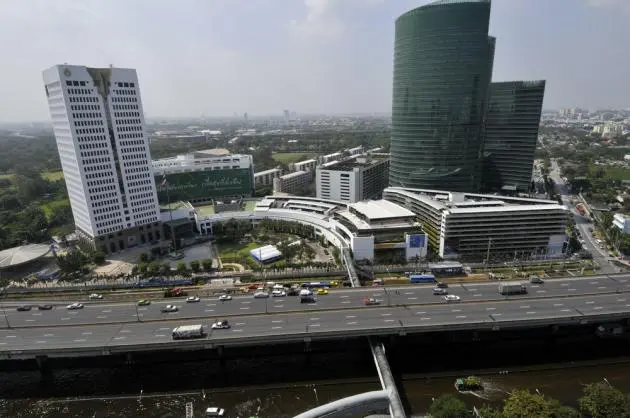


While the Energy Ministry is doing the right thing in seeking to distance itself from PTT Group, moving its offices from the PTT-owned Energy Complex is not the right way to go about it.
Both organisations have come a long way from the days when the national energy company was a full state enterprise as the Petroleum Authority of Thailand. However, although it was privatised and listed on the Stock Exchange of Thailand as PTT in 2001, the close relationship between the regulator and the regulated unit has not ended. Several officials of the ministry now serve as directors of PTT or its subsidiaries, a situation that has naturally led to criticisms of favouritism.
Realising this, newly appointed Energy Minister Arak Chonlatanon said last week that it was time for the ministry to distance itself from the energy group.
“The Energy Ministry has to make it clear that it is the regulator of the energy industry, not an agency that enjoys joint benefits with the private sector,” he said while unveiling the ministry’s policy on Friday. “We’re studying and seeking a newly appropriate location for the Energy Ministry’s offices.”
Arak said moving the Energy Ministry from Building B of the Energy Complex, a few metres from PTT’s headquarters, formed part of the plan to strengthen the image of independence. He is convinced that in sharing the same premises as PTT, it is normal for people to see the energy minister with PTT executives and get the wrong impression that both are involved in policy-making.
Yet moving offices is not the answer if the ministry wants to shrug off the perception of a special relationship with PTT. Offices do not determine the closeness of a regulator to the regulated. For years, the SET was headquartered at Sindhorn Building on Wireless Road, which was also home to many securities firms. There were no charges of favouritism, even though some of the companies’ directors served as SET directors.
The Securities and Exchange Commission also rents space in an office building, which is also available to all types of tenants, although unfortunately there are no securities firms located there.
Sharing the same roof is not a problem, as long as the rules and actions of the occupants are clear.
Claims of Energy Ministry favouritism originated years ago, mainly after the ministry was created during the Thaksin Shinawatra administration. PTT privatisation was the main cause of the criticism, as prime minister Thaksin was rumoured to have benefited personally from the share sale.
With his sister Yingluck now in charge of the country, such rumours take further root, becoming even stronger when PTT Exploration and Production (PTTEP), a subsidiary of PTT, won exploration licences from Burma after an official government visit to the country. There was also a rumour that PTT is channelling its investment to ventures linked to Thaksin.
Criticism strengthened when the ministry protected PTT’s land-expropriation rights for gas-pipeline construction, when it was no longer 100 per cent owned by the government. Consumers took the issue to the Administrative Court, where they won their case.
As to the link with Thaksin, that is something the ministry can do nothing about. Like many top listed firms, PTT has a long list of shareholders, including some who hold stakes under overseas companies’ nominee accounts. And it is difficult to prove the status of absolute shareholders.
In any case, the ministry is required to give full support to overseas expansion by Thai companies, PTTEP in particular. The stakes are high, as the subsidiary contributed 60 per cent of its earnings to PTT last year. More than 50-per-cent-owned by the Finance Ministry, and more than 10 per cent by the Vayupak Fund, PTT remains a state enterprise.
Yet Arak should realise that criticism will continue if the ministry acts in a way that shows favouritism towards PTT. It is true that the energy group has been the major tool in carrying out several policies – chiefly concerning retail fuel prices, subsidies for liquefied petroleum gas (LPG) and the distribution of natural gas for vehicles (NGV).
That may explain why the ministry has failed to reassure the public over fair pricing of NGV. Only last week, it approved a study to verify the pricing structure, but with Bt1.5 million in funding from the Oil Fund, which collects money from all fuel users – not from NGV users, who are still using the fuel at a subsidised price.
Moreover, Arak should realise that criticism over the “special” closeness will remain as long as the ministry’s officials still sit on the boards of PTT and its subsidiaries, without a proper dividing wall defining the scope of their actions. Norkun Sitthiphong, permanent secretary of the Energy Ministry, is now PTT’s chairman, despite a brief interval when he resigned for reasons of transparency.
Arak also insists that officials will remain directors of PTT and its subsidiaries, as PTT Group is a pivotal organisation for implementing the ministry’s energy mission. “We need to have our people on PTT’s board of directors. Whether we can clear the unwanted image depends on the manner of our representatives,” he said.
He could do more in this regard. In the business world, to ensure transparency, directors with a conflict of interest in an agenda item abstain from voting on the issue. This was a big issue when Thailand first experienced an LPG shortage and PTT needed to take care of imports, for which the ministry’s representatives on the board acted for the company’s benefit. The ministry knew that imports were necessary, as the number of NGV stations was limited (also because of price-fixing, which discouraged new investment). PTT had to take care of the problem, albeit at a cost that was borne by all stakeholders. As a result, the ministry achieved its supply mission.
In addition, during last year’s devastating floods, while many other companies launched their own relief programmes, PTT was seen tying its programmes in with those of the ministry.
Thailand has nearly 100 state enterprises. For some of them, especially specialised financial institutions, even though they entirely belong to the state, they have public-service accounts where the costs of public services are booked and from which they are entitled to government subsidies. But that is not the case for PTT, and this leads to complaints from shareholders. Even Thai Airways International has a better status in this respect, as it no longer subsidises fares for government officials.
With the Energy Ministry planning to finalise energy-price restructuring in April, when LPG and NGV pricing will better reflect actual costs, criticism over favouritism will flare up again and complaints will come from consumers.
As long as PTT’s status – either as a listed company or a state enterprise – is not clear, fair treatment to all stakeholders is not assured. As such, a relocation of the ministry’s offices is the last thing that would clear up the distorted image. Bear in mind that when the ministry moved from Rongmuang Road, the Internet-protocol phone system alone at the new premises cost it Bt10 million.
