
Curb your inflation expectation: BOT says


The Bank of Thailand has sent a strong message that infla?tion is under control despite oil price spikes, amid high inflation expectation which is feared to give birth to a vicious cycle of endless price increases.
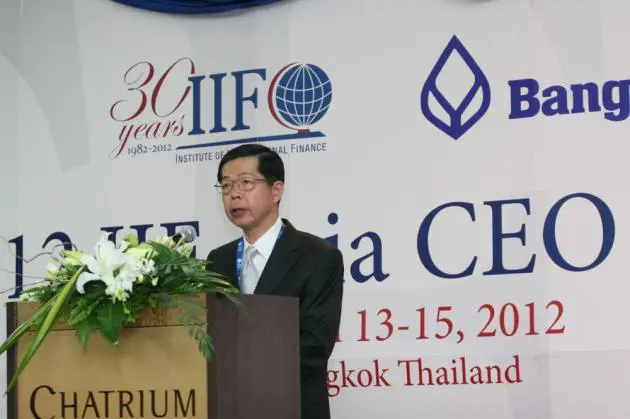
On the sideline of Bangkok Bank-sponsored 2012 IIL Asia CEO Summit, Bank of Thailand Governor Prasarn Trairatvorakul yesterday said that the central bank is worried about the currently high inflation expectation, as this could lead to goods prices increases and a vicious cycle which is difficult to end.
"I'm saying here that there's no need to worry about inflation. The more worries, the more chaos. I can?not speak for the MPC (Monetary Policy Committee - on the policy rate), but what I'm trying to say is it's in the central bank's policy announced early this year that the monetary policies would be used to support recovery. There is no plan to hike the policy rate at this moment. On the oil price, even if it hits $140 per barrel, the inflation would be within target ranges, both core and headline inflation ranges," he said.
Under the central bank's moni?toring, every 10 per cent increase in oil prices would raise the consumer price index by 0.3-0.4 percentage point.
The central bank bases its policies on the assumption that Dubai crude would average $103 per barrel this year. Prasarn said that the assump?tion level could be raised to $110, following the recent spikes on tight demand and supply.
Prasarn yesterday assured all that inflation would not exceed the cen?tral bank’s target, despite forecasts that Dubai crude oil would average above US$140 per barrel this year, he added, referring to the central bank’s stress test. The central bank targets core inflation at 0.5-3 per cent and headline inflation at 1.5-4.5 per cent.
Against fears that the MPC may raise the policy rate at the March 21 meeting, he said this may not hap?pen as monetary policies this year would be geared towards supporting economic recovery.
Meanwhile, Fiscal Policy Office Director-General Somchai Sajjapongse said yesterday that the unit is revising inflation and pro?posing short and long-term meas?ures to ease impacts on the cost of living. He insisted that the measures would be innovative and would not severely pressure the fiscal position.
At end-March, the FPO will also revise the economic projection upward from 4.5-5.5 per cent, due mainly to public spending which would start entering the economy in March. Somchai is convinced that the economy should expand by over 5 per cent this year.
The Cabinet on Tuesday approved the Bt800 billion borrowing, which would push public debt to 48 per cent of gross domestic product in 2013, near the 60 per cent thresh?old.
The central bank governor is hopeful that the government would try to cut down budget deficits, if there is no another disaster that requires another injection. He noted that if the deficit of 2.4 per cent of GDP is maintained, within 6-7 years, the public debt could breach the threshold. Meanwhile, the revenue base must also be expanded while efficiency of public spending must be the priority. To plug inefficient spending, he also noted that spe?cialised financial institutions' books must be transparent.
As crude price hovers near $125 per barrel, Deputy Finance Minister Thanusak Lek-uthai said yesterday that the Cabinet would be asked to extend diesel excise tax waiver from end-March to the middle of this year, to help control the cost of living. While the Oil Fund is bearing gas subsidies and operating in the red, the Excise Department cannot re-impose the tax now. The excise tax has been cut by Bt5 per litre since April 21, 2011.
He said that the waiver would be just a short-term measure, to address the government's concern on cost of living. However, in the medium term, it must be re-imposed and the government may need to devise long-term plans to lower logistics cost.
"The oil prices are on the rise. But if there is no more hurdle and as the government's stimulus measures should show results in the middle of this year, then, we will need the pub?lic permission to raise the tax," he said.
Prasarn also supported the idea to maintain the subsidies for now and change the energy price structure thereafter, to reduce fiscal burden and distortion in energy consump?tion.
"Lowering subsidies is a right thing to do, as such pose fiscal bur?den and distort energy consumption. Still, the timing is important. Solving one problem could give birth to another. Oil prices are on the rise now due to geopolitical problems in the Middle East. A cut in subsidies could be delayed then, or it might create another problem. As I said before, this should have been avoid?ed from the first place, as it's hard to be abolished," Prasarn said.
