
Increasing oil prices pushing inflation expectations: BOT


Play
Bank of Thailand Governor Prasarn Trairatvorakul attributes the recent spikes in goods prices partially to inflation expectations based on the upward trend in oil prices following geopolitical tension the Middle East.
To keep inflation in check, the central bank will undertake periodic surveys on the inflation expectations of business operators and consumers, to see what they expect in the next three, six and nine months. Prasarn noted that in anticipation of higher inflation, operators tended to raise product prices while consumers started to hoard.
“What worries us is the oil prices. Every 10 per cent increase in the oil price boosts the consumer price index by 0.3-0.4 of a percentage point. Inflation expectation is a culprit now.
If people are convinced that inflation will rise in the next six to 12 months, goods prices will be raised. And it would be difficult to untangle the chaos,” he told the meeting on Friday.
If people are convinced that inflation will rise in the next six to 12 months, goods prices will be raised. And it would be difficult to untangle the chaos,” he told the meeting on Friday.
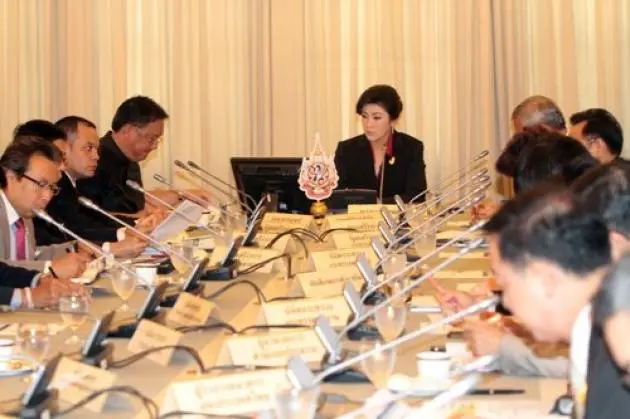
Meanwhile Prime Minister Yingluck Shinawatra called for an urgent meeting with key economic ministers and economic agencies in light of escalating inflation. Among those attending the meeting were Deputy Prime Minister and Finance Minister Kittiratt Na-Ranong, Commerce Minister Boonsong Teyapirom, and National Economic and Social Development Board Secretary General Arkhom Termpittayapaisith.
On the minimum wage policy, Prasarn said that it would be a plus to the economy if the 40 per cent wage increase were matched with productivity, as this would increase the low-income earners’ pay as well as economic competitiveness.
While saying that he supported the wage hike, he was concerned that most workers would be unable to keep up with new technology, at least initially.
While saying that he supported the wage hike, he was concerned that most workers would be unable to keep up with new technology, at least initially.
He said that while this would put pressure on inflation in the short term, Thailand is geared towards technological development and better income distribution if it can manage associated challenges.
He noted that for now, no measures are needed to address inflation. Although oil prices are rising, this would not push up the prices of all products. Should the government want to ease the extra burden, it should focus on those hit by higher oil prices but should not overreact.
Meanwhile, any policy that could push up oil prices can be delayed.
Meanwhile, any policy that could push up oil prices can be delayed.
Yingluck assigned the Commerce Ministry to monitor the supply chain, as farmers are complaining about low crops prices while many business operators are attempting to raise product prices.
She noted that the government must sustain the situation until the third quarter, when the manufacturing sector would fully recover from the floods. After that supplies should return normal and prices should ease.
She noted that the government must sustain the situation until the third quarter, when the manufacturing sector would fully recover from the floods. After that supplies should return normal and prices should ease.
At the meeting, Arkhom of the NESDB said that inflation increased in the first two months of this year, at 3.4 per cent compared to about 3 per cent in the same period last year.
He said that inflation continued the upward trend since October 2011, probably due to the flood disaster, which pushed up food prices. In the first two months, while agricultural crops were cheaper, the index of meat prices was up 12 per cent, food seasoning sauces 11 per cent, ready-to-eat food 12.4 per cent, and outside dining 5.3 per cent.
The minimum wage policy, to take effect on April 1, was cited as an additional pressure to inflation. He noted that production cost slightly rose due to subsidies on gas and diesel, adding that distribution of cheap items as well as free bus services should help maintain the cost of living.
He said that inflation continued the upward trend since October 2011, probably due to the flood disaster, which pushed up food prices. In the first two months, while agricultural crops were cheaper, the index of meat prices was up 12 per cent, food seasoning sauces 11 per cent, ready-to-eat food 12.4 per cent, and outside dining 5.3 per cent.
The minimum wage policy, to take effect on April 1, was cited as an additional pressure to inflation. He noted that production cost slightly rose due to subsidies on gas and diesel, adding that distribution of cheap items as well as free bus services should help maintain the cost of living.
The free bus services will end in April, while diesel subsidies of Bt5 per litre would end on March 31.
