
Samsung plans Thailand base
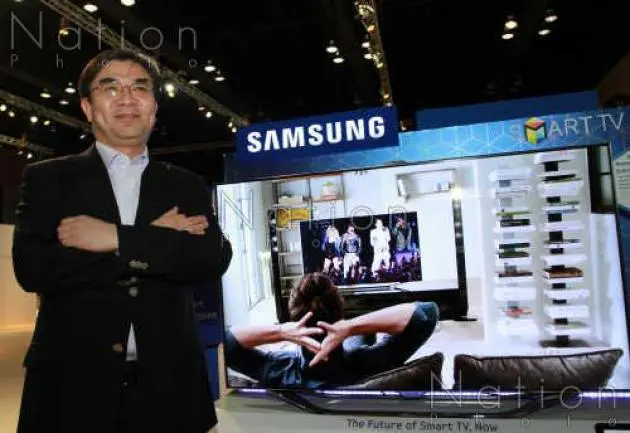


Samsung Electronics is seeing strong growth of its visual display business, especially smart TVs, in Southeast Asia, hence it is selecting certain television factories in Thailand, Malaysia and Indonesia to deliver products to Asean to benefit from the As
The key criteria include cost effectiveness and short delivery lead times, Hyunsuk Kim, executive vice president, told The Nation last week.
Thailand will be a good candidate for serving AEC members in the near future. Samsung’s facilities, located in Chon Buri’s Sri Racha district, produce many electric appliances, such as televisions, refrigerators, washing machines and air-conditioners.
Kim, who is in charge of the Korean consumer electronics manufacturer’s visual display business, said Samsung aims to be the leading TV-maker here as well as in key markets in the region, by providing the best products, strongest service and quality, and good entertainment solutions for consumer happiness.
“We want to be the most loved brand in Thailand,” he said.
Samsung will focus on emerging markets in Southeast Asia, such as Thailand, which have strong growth potential, thanks to the big populations and sharply rising income.
The region has doubled its contribution to Samsung’s TV business from less than 10 per cent a couple years ago to 20 per cent today. About 30 per cent and 35 per cent of the company’s TV sales come from the US and Europe, respectivel.
Flat-screen TVs in Southeast Asia are still fewer than CRT (cathode ray tube) TVs, or less than 30 per cent of all TV sets installed in homes. In developed markets such as the US and Europe, almost all household TV sets are flat screen.
“In Thailand for instance, most people are on analogue broadcasting. They are, however, in the transition to digital broadcasting. That will open up a lot of opportunities for our TV products, such as smart TVs, which work quite well with digital technology,” he said.
In Thailand, half of TV sales are CRT TVs, but they will be fully replaced by digital flat TVs within five years.
Samsung still makes a very small number of traditional CRT TVs to serve demand in some markets like India and Africa.
The company will this year focus on smart TVs, which feature higher applications and a different human interaction.
“Unlike traditional TV sets, whose functions are controlled by a remote handset, what we’re doing is to let you command the TV with your voice. We have also gesture recognition.”
The new generation of Samsung smart TVs – the ES8000 – was launched in Korea last month and is being rolled out in other countries, including Thailand, this month. Supporting 23 languages, the new smart interaction TV series provides a whole new way for consumers to interact with TV by voice, motion and face recognition.
The company expects more than half its TV business this year will come from smart TVs.
While Asia is recognised by the company as a growing region for its visual display business, the company still sees huge demand for flat-screen TVs in some matured markets such as the US and Europe.
“Many consumers in the US and Europe are still using CRT TVs for their second room. They, however, tend to replace their second room TVs with the new flat-screen panels. Samsung wants to grow its TV business in this promising area,” he said.
Southeast Asian consumers have been quick to adopt mobile technologies, like smart phones and tablets, which allow them to access their content on the go. They expect not only greater accessibility, but also greater, more compelling content – all of which are needs met through Samsung’s vision for the future of smart TV.
Heading into its seventh straight year as the global TV market leader, Samsung counts as key success factors its ability to introduce innovative products that are different from its competitors, with different designs, different technology and different behaviour of consumers, he added.
