
3G+ for health/education


Mung Kanjanapradit, a resident of Nongsamong Village in Wang Nam Kheio district, has suffered from diabetes for years. But without a specialist in this field at her village, every month she had to go to Wang Namkheio Hospital which is 20km away for physic
Each visit, she had to prepare Bt500 for transportation cost.
All that hardship for the 48-year-old woman went away, as the doctor can now view her condition through computer screens and accordingly assign the proper medicine. Mung can’t help but being thankful to True Group, which recently visited her village with the provision of free 3G service.
Under "3G+ for School & Community Project", a new corporate social responsibility initiative riding on True Corporation’s TrueMove H 3G+ service, patients of Nongsamong and other five villages under the care of the Nongsamong Primary Care Development Centre can seek remote medical advice and treatment from their doctors based in Wang Nam Kheio Hospital. With an internet dongle that promises speed upto 7.2 mbps, Google’s Hangout programme and built-in web camera, people from both sides can talk face to face.
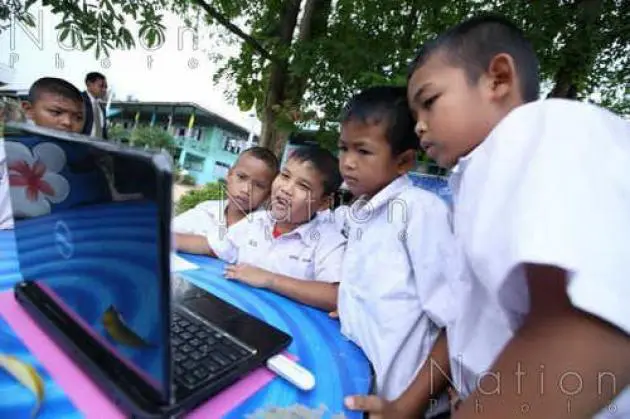
True Move is concluding the number of primary care centres to receive such free services. Eligible are the centres located near 3,500 schools under the True Plook Panya programme, to where documentary channels under TrueVisions and digital media materials are provided. True is also providing the access to another 1,600 schools. First of them is Ban Nongwang school in the Udomsub district of Wang Nam Kheio, allowing teachers and students to faster Internet connection.
According to True President and CEO Supachai Chearavanont, as its commitment to promoting education, while the number of True Plook Panya schools is being expanded, the company hopes that this 3G service will compliment the key project.
"Internet access in an indicator of the economic prosperity. This will help assure people’s access to knowledge, which is the basic of economic development," Supachai said, after delivering the service to the primary care centre and a school in Nongsamong Village.
According to Yodjaras Meemungkung or "Mor Kaew", head of Nongamong Hospital, the service would benefit residents largely. He noted that his hospital is now catering services to 5,000 villagers from six villagers. On a daily basis, it tends about 30 patients. While most of them seek treatment for common illness like fever and work fatigue, some suffer from diabetes and high blood pressure which needs special treatment.
"With real-time communication, nurses and other medical personnel of small hospitals can seek advice from specialists on diseases needing serious and/or immediate treatment. It gives us more confidence in treating patients," said Yodjaras. "Most importantly, patients do not need to travel far to big hospitals just for a check-up on some uncertain medical condition. This really helps them to save money as most of them cannot afford to travel long distances," Mor Kaew said.
Wicharn Kidhen, director of Wang Namkheio Hospital, dubbed this as a medical treatment revolution.
He said that the 3G network brings improvement to both sub-district and district hospitals. When small hospitals can provide immediate medical services, the big hospitals can also focus on its patients. Meanwhile, 3G technology can help save money for poor patients.
"This is good particularly for emergency cases such as heart attacks. Previously we had to fax their Electrocardiogram (ECG) to Maharaj Hospital in Nakhon Ratchasima, which is not real time," said Wicharn. "If the doctor there can view the ECG real time, that would help in the diagnosis and promise faster and better treatment. Don’t forget that a minute counts in saving a human life," he said.
