
Coping with food inflation: 'Let them eat cake'


Play
Have you noticed how expensive food has become these days?
According to the latest statistics from the Commerce Ministry, inflation will likely reach 3.75 per cent this year on rising prices of ready-to-eat dishes and energy. Core year-on-year inflation, which excludes food and energy prices, was a modest 2.72 per cent in February, but what is really worrying is the food and beverage sector, where prices rose by 7.18 per cent. I dread to think what the inflation numbers will be like if we have another major flood this year on top of the new daily minimum wage of Bt300 imposed in some provinces in April.
In an environment of rising food prices, the government of Prime Minister Yingluck Shinawatra is trying to alleviate the situation by encouraging shops to join the Blue Flag scheme, offering cheap consumer goods. How successful this scheme will be remains to be seen.
Meanwhile, it is claimed that by teaming with up with Thailand Post, the Internal Trade Department will be able to deliver goods with 50 per cent lower logistic costs than the private sector.
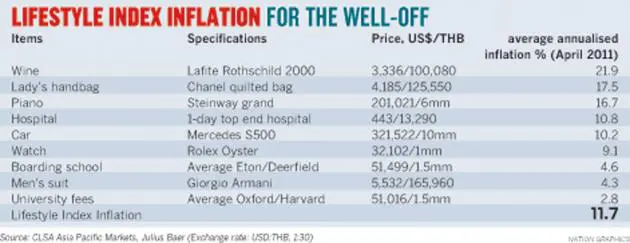
If you think it’s tough trying to make ends meet with a 3.8-per-cent inflation rate, rich people have it tougher. A Swiss private bank, Julius Baer, did a survey on how rich people in Asia consume. And when they say rich, they are referring to those with more than US$1 million (Bt30 million) in financial assets, excluding properties, commonly referred to as high-net-worth individuals (HNWI). As expected, the items in their basket of goods are different from ordinary people (see Table 1), such as Bt100,000 bottles of wine, Bt10-million cars and tuition fees at exclusive boarding schools. On average the prices of these items have been rising at nearly 12 per cent per year.
Whether you are facing 3-per-cent or 12-per-cent inflation rates, like it or not, inflation is a part of our everyday life. And it’s not just goods prices that are rising. The cost of labour has been rising steadily too.
I was surprised to learn from my mother that when I was a toddler my nanny got paid Bt350 a month. And when my son was born three years ago, my wife needed help with the newborn, so we hired a nurse to come and help out at home. The going rate was Bt350 an hour. It’s pretty scary what inflation can do to the value of money – 50 years ago Bt350 could buy one month’s worth of labour, but today it can only buy one hour’s worth.
When investing with inflation in mind, you need to look at your expected investment return on a net basis. Many big banks are now offering 10-year bonds with a coupon of 3.5 per cent. After deducting the current inflation rate of 3 per cent, you are left with a paltry 0.5-per-cent return.
By being too risk-averse and putting too much money in fixed-income instruments, you will definitely see a decline in your standard of living because of the negative investment return net of inflation. But given the volatile nature of the stock market, many investors cannot sleep too well at night either.
Admittedly, we all have different risk-return parameters, but a properly diversified portfolio across different asset classes comprising stocks, bonds, commodities, real estate and other investments should make up the core portfolio for most people.
Deep down I am very concerned about the threat of food inflation in the coming years. Telling poor people to buy their food from Blue Flag shops is a bit like Marie Antoinette, wife of Louis XVI and queen of France on the eve of the French Revolution, uttering an insensitive remark upon hearing peasants’ complaints that there wasn’t enough bread to go around. “Let them eat cake,” she supposedly said.
You don’t have to be a historian to know what happened to the French monarchs when people could not afford to feed their families. As for those readers who are not history buffs, both Louis XVI and his queen lost their heads in 1792 after the overthrow of the French monarchy and the establishment of the First French Republic.
Teera Phutrakul, a certified financial planner, is the founder of JT Financial Planners, an independent financial-planning firm. He may be contacted at www.jtplanner.com.
