
Higher govt salaries widen income gap: TDRI


Play
There is likely to be a flow of people with a bachelor's-degree education or lower from the private sector to the state sector, as the income gap between the two is expected to widen as the minimum salary level at state agencies increases, according to th
Worawan Chandoevwit, research director for the TDRI’s human resources and social development programme, said a study by the institute also finds that the current average income throughout the working life of those employed in the private and state sectors, and whose education is bachelor’s level or lower, is appreciably different if they work outside Bangkok.
The TDRI’s study will soon be submitted to the government for consideration.
The gap will widen even further once the policy to increase the starting salary for newly graduated civil servants to Bt15,000 per month takes effect.
The policy was supposed to have been implemented this month, but the government has postponed it to next January. Prime Minister Yingluck Shinawatra said the government was concerned about the impact early implementation would have on the private sector. Worawan said that regardless of the area of work and a person’s educational qualifications, workers in the private sector received lower salaries than those engaged in state agencies and state enterprises.
As of 2010, the average monthly income of workers in the private sector was about Bt7,000, whereas those in the state agencies and state enterprises earned about Bt16,000 and nearly Bt25,000 respectively. The gap will widen for those with a bachelor’s degree or lower after
the salary-hike policy becomes effective.
The TDRI conducted surveys of workers in both the state and private sectors. The samples used were those aged 25 to 34 in 1980, with all income, including salary, bonus, overtime, transport and other allowances, being taken into account throughout their working lives.
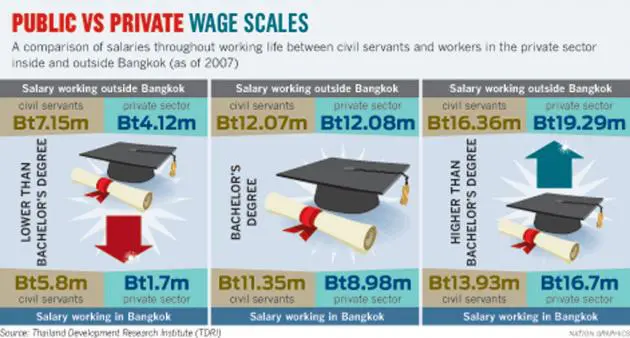
According to the study, working-life income for civil servants with an education lower than bachelor’s level as of 2007 averaged Bt5.8 million for those working outside Bangkok, and Bt7.1 million for those working in the capital.
Private-sector workers with a similar education had an average working-life income of Bt1.7
million outside Bangkok, and Bt4.1 million if they worked in the capital.
The comparable figures for those with a bachelor’s degree were Bt11.35 million for civil servants and Bt12.08 million for workers in the private sector.
Worawan said that as the gap between the bachelor’s-level figures was quite small, once the government raised the minimum salary for civil servants with a degree to Bt15,000 per month, people would be likely to seek employment in the state sector.
She added that the average salary for workers in the private and state sectors with an education below bachelor’s level, and working outside Bangkok, was quite similar during the ages of 25 to 34. The former get less than Bt2,000 per month, while the latter earn Bt2,000.
The gap widens as they get older, and is markedly wide when they are 55 to 64, when the average salary of those in the private sector is around Bt5,000 per month, while those in state agencies earn Bt13,000.
As to those working in Bangkok, employees with an education below bachelor’s level get a similar average salary of Bt2,000 from the ages of 25 to 34, but the gap again becomes appreciable as they get older.
From 55 to 64, the average salary of those in the state sector is Bt19,000, while those in the private sector earn Bt12,000.
Civil servants with a bachelor’s degree and working outside Bangkok on average get a lower salary than workers in the private sector.
The gap is wider if those workers are in Bangkok.
Workers with a higher education than bachelor’s level working in both Bangkok and outside the capital get a higher salary if they work in the private sector.
“The government’s spending on the salary hike [for civil servants] is likely to be more than Bt8 billion per year, excluding the pension fund contributed by the government. This improved benefit will attract low-skilled workers to the state sector as well,” Worawan said.
