
Disastrous farm subsidy policy must be abandoned
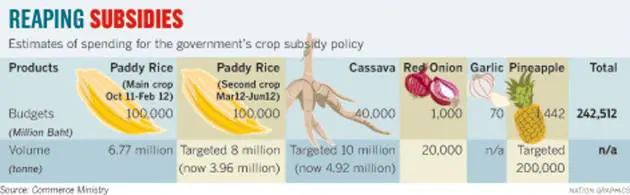


It may be the right time for the Yingluck government to revise its farm subsidy policy as it has not only spent a huge budget on supporting many farm goods, but it is also being questioned by the public on its mismanagement of stockpiles and the overall p
All the government’s price intervention programmes for rice, cassava, red onion, garlic and pineapple have cost mountains of money but failed to shore up prices and finally ended up as a waste of money as some crops became completely spoiled.
The Yingluck government has high confidence in bringing back the pledging scheme to impose prices that are higher than the market. The policy was conceived in the belief that intervention will pull up market prices.
After the pledging scheme for paddy rice was implemented for six months, the government had already spent Bt200 billion for two rounds. However, rice prices in the market have not yet reached the government’s target and overseas orders for Thai rice have evaporated due to the huge gap in prices between local and rival exporters.
Under the price subsidy programme, the government has collected about 9 million tonnes of milled rice, of which 2 million tonnes are old rice, 4.5 million tonnes (6.77 million tonnes of paddy rice) are from the last main crop and 2.574 million tonnes are from the second crop that followed this year. And the scheme is not yet finished.
The government expects that the pledging programme will bring in about 8 million tonnes of paddy rice (5.3 million tonnes milled equivalent), or 72 per cent of the total off-season harvest.
The government believes that there has been no overstocking, as the stored rice will be gradually released. However, the country’s slow exports and inefficiency in pursuing government-to-government deals will see the government’s rice stockpiles climb to 10 million tonnes.
Thai rice exports have fallen to an average of 500,000 tonnes a month now, from almost 1 million tonnes a month last year.
Despite the huge rice stocks, the government has exported only 500,000 tonnes for fear of impacting domestic prices. As the government’s policy is to focus on government to government export contracts, it will certainly produce losses as the inventory must be sold at a "friendly" price.
Despite the high subsidised prices, domestic prices have not reached the government’s target of Bt15,000 per tonne for paddy rice, which is being quoted in the market at Bt10,800-Bt11,000. Meanwhile, farmers are not satisfied with the pledging scheme
Commerce Minister Boonsong Teriyapirom has insisted that the government will not revise the price pledging policy.
Thai rice exporters have voiced concerns that the high pledging price set by the government is destroying the country’s rice trading industry, which has been developed over more than half a century.
The government lacks efficient marketing arms for rice trading. In particular, the intervention in both prices and market mechanism is forcing rice traders to walk away from the business, a major rice trader has said.
Another failure is the propping up of the cassava price. The price has not yet increased in line with the government’s pledging policy. The budget from the government to shore up the price of this commodity has been doubled to Bt40 billion for the coming season.
The cassava price remains low at Bt1.30-Bt1.90 per kilogram compared with the government pledging price of Bt2.75-Bt2.90. Launched in February, the pledging scheme has purchased 4.9 million tonnes of cassava.
The government reasons that the subsidised price would ensure that farmers gain a real benefit as their production cost averages Bt2.20-Bt2.70 per kilo.
Recently, thousands of pineapple planters urged the government to allocate a budget to purchase their excess crops as they are facing a severe fall in prices.
Due to the intense pressure from the farmers, the government decided to budget Bt1.4 billion to purchase 200,000 tonnes of pineapples from the market.
It has been 20 days since the budget was approved, but the government has not started purchasing any pineapples from farmers due to the lack of efficient management arms to manage both the purchasing system and stockpiles.
In fact, the government’s most problematic project is the price subsidy for red onions. It had to spend Bt1 billion to finance the scheme. It targets to purchase about 20,000 tonnes.
Finally, the project has created not only a big loss but also a bad smell in the communities where officials had asked to stock the red onions, as most of them have rotted. The more than Bt300 million spent to subsidise red onions is melting away, leaving behind putrid odour.
Both farmers and local traders have complained that the government has not planned well on how to manage such a huge oversupply.
"The stale produce is good evidence of the government’s mismanagement and inefficient operations," one said.
In fact, the government should allow farmers to free themselves from subsidies by coming up with a long-term development plan focusing on yields and irrigation.
The Yingluck government should consider stopping the spraying of taxpayers’ money on wasteful projects and should stop being ashamed of revising all the pledging programmes. Any baht lost in the farm subsidy programme could have been used for other necessary projects that create wealth for the country.
