
Thailand capable of financing mega-projects: Virabongsa
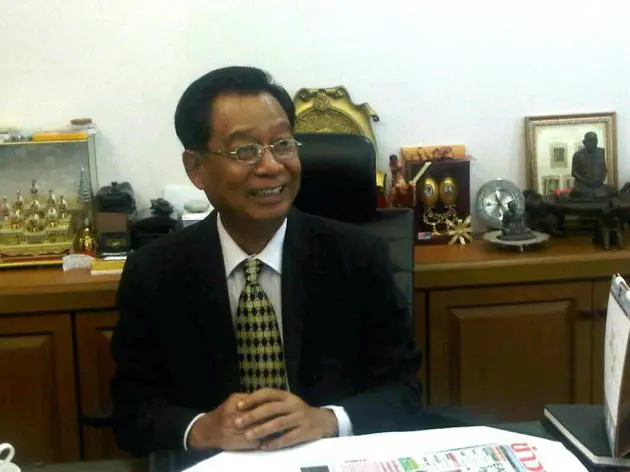


Former Deputy Prime Minister Virabonga Ramangkura is pushing for huge investment on mega projects.
He said to upgrade rail transportation over the next four to five years, the government has to accelerate investment in dual-track and high-speed rails.
“Instead of building high-speed rails linking Bangkok to Chiang Mai in the North, Nong Khai in the Northeast, Rayong in the East and Padang Besar in the South, we should first build shorter routes,” he said.
“These proposed routes are: Bangkok to Phitsanulok; Bangkok to Nakhon Ratchasima; Bangkok to Pattaya; and Bangkok to Hua Hin,” said Virabongsa.
He also suggested that Don Mueang Airport be reopened to ease traffic at Suvarnabhumi Airport by luring budget airlines to move to Don Mueang. Shuttle buses would transfer passengers between the two airports.
“Air Asia has agreed to move but the company wants an assurance from the government that it will not reverse its policy later,” he said.
Don Mueang currently serves domestic flights, but will also serve international flights while the government builds more runways at Suvarnabhumi, he said.
Gas pipelines that currently reach only Saraburi province must be extended to Chiang Mai, Nong Khai and Hat Yai, he said, and added that the government must overcome the opposition of vested interest groups like truck operators who are engaged in transporting gas and oil. They have long been successful in opposing the extension of gas pipelines.
The deep sea port on the Eastern Seaboard will be also be expanded as it is already facing congestion, he said.
New industrial parks will be set up on the Eastern coast as investors will not expand their production in the floodhit areas of the Central region, said Virabongsa.
He conceded that one challenging issue is how to provide adequate fresh water to the Eastern provinces such as Chon Buri and Rayong.
He said more investment to rehabilitate natural resources is needed to promote tourism.
Investment in the masstransit system in Bangkok also must be accelerated, he said.
As Thailand lags behind other countries in information technology, Virabongsa said the law governing IT regulator might be changed in order to speed up IT development. He blamed the strict conditions under the current law regarding qualifications of the regulator committee.
Virabongsa insisted that the government has the financial resources for the mega-project investments.
“We have international reserves of $180 billion after 15 years of savings since the 1997 financial crisis,” said Virabongsa.
He dismissed criticism of using international reserves, saying the economic landscape has changed since the previous crisis.
The government will keep public debt under 60 per cent of GDP, he said.
He said private insurers have come back to do business as seen in the drop in premium for natural catastrophe to 3 per cent from a peak of 15 per cent during last year’s massive flooding.
People have so far bought protection coverage worth about Bt300 million from the government-run insurance fund, which could provide protection coverage up to Bt500 billion, he said. This suggested that the insurance industry was back to normal, said Virabongsa.
Mega-project investment over the next five years is estimated to be about Bt2.3 trillion, according to the National Economic and Social Development Board.
