
Australian researchers tackle emissions


Play
Australia is one of the countries facing greenhouse effects. The consequences are so immense that the country needs to allocate a bigger budget to develop technology, with focus on clean coal and alternative energy that will help reduce carbon emissions (
Clean coal is a must given that coal accounts for the majority of fuel used in power generation.
At present, coal is the main resource accounting for 80 per cent of total resource, to produce electricity in Australia because the country has more coal and it also exports coal.
Jim Smith, the deputy chief at Australia’s national science agency – Commonwealth Scientific and Industrial Research Organisation (CSIRO) – said that the CSIRO is working at each of these levels to reduce greenhouse gas emissions and help develop technologies, change behaviours and map the pathway to clean, viable and a secure energy future.
To pursue the goal, CSIRO has a budget of 1.2 billion Australian dollars (Bt39.6 billion) for research and development, about 10 per cent of the total A$114 million spent to energy research.
One of the researches is focusing on how to use solar energy efficiently. Solar Thermal is one of the ways to use and keep solar energy efficiency. CSIRO spent A$5 million, funded by the Australian government’s Australian Solar Institute (ASI), as part of the Clean Energy Initiative.
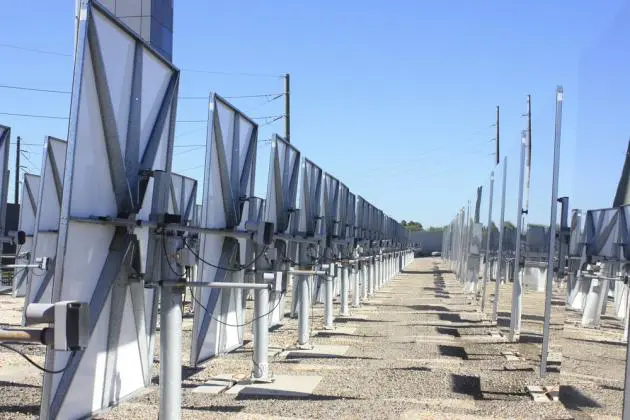
Solar Thermal is designed to preserve solar heat and use in the turbine to generate electricity. The system involves a 30-metre-high solar tower and high temperature receiver, and a 4,000-square-metre field of 450 mirrors called heliostates. The heliostates reflect sunrays to the solar tower with the air turbine and air compressor. Then fresh air is drawn into the compressor, compressed and transferred to the solar receiver. The compressed air is then heated to 900 degrees Celsius using concentrated solar energy. The hot air is then expanded through the 200 kilowatts turbine to generate electricity. Electricity is then fed into the grid or used by CSIRO to power the site. The electricity from the demonstration project in Newcastle on the 4,000sqm areas was enough for 200 residents located close to the site.
Smith added that the Solar Thermal in Newcastle is a demonstration project that will be developed into a commercial venture.
If Solar Thermal proves a success in commercial terms, it will create sustainable use of solar energy rather than the conventional system that cannot be used when there is no sunshine. This is also a part of the plan to reduce CO2 in the air, he said.
CSIRO is also researching about clean coal technology in a joint effort with the government of Queensland through the Queensland Centre for Advanced Technologies (QCAT) in Brisbane.
CSIRO’s team leader for coal utilisation David Harris said that 80 per cent of electricity in Australia came from coal. Coal currently provides 29 per cent of the world’s primary energy needs with the International Energy Agency projecting this will grow to 50 per cent by 2030. Increasingly this future demand must be met within a carbon-constrained economy, requiring the development of new technologies.
High efficiency and low emissions energy from coal is the way. CSIRO has undertaken a study called “Gasification and Syngas technologies”. The reducing nature of the gasification process means that conventional emissions, such as nitric oxides, and sulfur oxides, are produced as commercially valuable ammonia and sulfur products.
Furthermore, the mineral matter in the coal is converted to high density, insert, marketable slag, avoiding the production of fine particulate. Gasification is also a highly flexible technology able to produce a range of energy products such as liquid fuels, chemicals and fertilizers.
“This is only research in the lab and it will take time to develop it commercially in the future but it is the way to use coal to produce electricity, by reducing toxicity in the air,” he said.
Meanwhile, QCAT is also researching how to develop bio-fuels by setting up the Tarong Power Station, a 1,400-megawatt power station. This power station generates coal-fired power that is also designed to have a bio-fuel system by cultivating algae to help reduce emissions by 1,000 tonnes per year through collection of carbon dioxide from flue gases. This system is being demonstrated in Thailand at the Ratchaburi Power Plant.
Evolving new technology to produce electricity through alternative sources and researching technology to reduce toxics from conventional technology are the ways to get green electricity and reduce the greenhouse effect amid worldwide climate change.
Some of technology can be used in Thailand, especially the clean-coal and solar cell technology but the usage would depend on whether people can afford them.
