
Tango for the 'ball season'
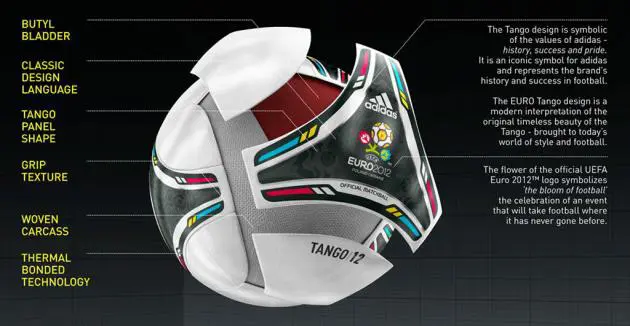


Germany firm Bayer MaterialScience revealed some unique properties and features of the "Tango 12", the official soccer ball for this year's European Soccer Championship, which it took 2 years to develop jointly with Adidas.
A special feature of the Tango 12 is the texture of the surface, which is similar to the structure of denim. Besides some interesting optical and haptical effects, it is also responsible for the particularly good flight properties of the ball.
Fewer cut edges and greater curvature also mean fewer seams and edges in the outer shell. Soccer players are more likely to strike smooth surfaces and can therefore control the ball with greater precision. Measurements of the diameter at 16 different points for each ball show that the deviation between the largest and smallest diameters is no more than one per cent.
--New design, proven technology
The properties of soccer balls have improved continuously since synthetic materials were first used in ball technology.
The outer shell of the Tango 12 consists of a total of five polyurethane layers.
The innermost layer is an adhesion coating that connects the textile substrate to the layers above. On top of this is a syntactic foam layer, roughly one millimetre thick, made up of millions of gas-filled cells. The ball therefore quickly regains its spherical shape after being kicked, ensuring optimal flight.
The ball is finished off with three compact polyurethane layers of various thicknesses.
They make the surface highly resistant to external factors and abrasion, but also highly elastic, ensuring the ball retains its unique appearance over the long term.
The individual panels of the ball shell are bonded together using patented Thermal Bonding Technology and thus absorb essentially no moisture. As a result, the ball is no more than 0.1 per cent heavier even in heavy rain and is almost completely waterproof. A raw material development from Bayer MaterialScience is used here, too – the thermo-activated adhesive is based on a waterborne polyurethane dispersion from the Dispercoll product line.
The design of the adidas Tango 12 is reminiscent of the classic “Tango”, the ball used at Fifa World Cups and Uefa Euro tournaments in the early 1980s. However, a new feature is the reference to the two host nations Poland and Ukraine, which are represented by the colors of their flags. A graphic also recalls soccer’s key characteristics – unity, fighting spirit and passion. Another image is devoted to the ornamental art of paper cutting – a tradition in rural areas in both host nations.
