
Piyasvasti files lawsuit over 'unfair' firing
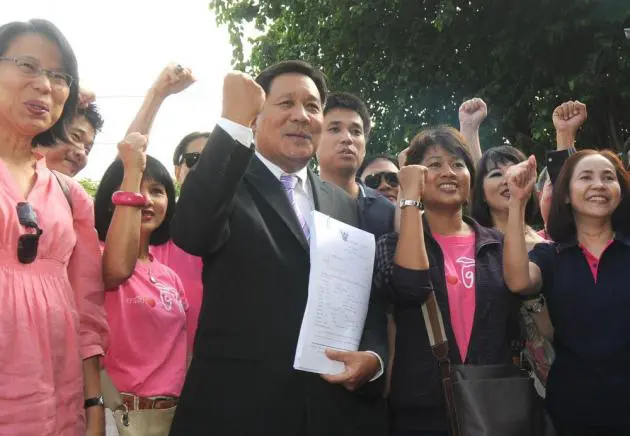


Thai Airways International's former president Piyasvasti Amranand today filed a lawsuit against the company's "unfair dismissal order", which terminated his employment contract a year before it was due to expire.
He told reporters yesterday that the Central Labour Court would be asked to rule on two options: THAI must reinstate him as the airline’s president or the company must pay compensation until his employment contract actually ends on July 11, 2013.
"Money is not the issue here, but I’d like to set the management standard for state enterprises, for the sake of transparency," he said.
The THAI board of directors late last month decided to terminate his contract prematurely. As he was notified a month in advance with a six-month compensation package accordingly to the contract’s conditions, yesterday was his last day in office.
Asked whether he would also sue Ampon Kittiampon, chairman of the board, Piyasvasti acknowledged that this was under consideration.
Ampon in May cited lack of communication unity with the board for the dismissal, only to announce days later through acting president Chokchai Panyayong that conflicts over a plan to acquire new aircraft was the reason. To the House of Representatives committee on transport, at a meeting attended by Piyasvasti, Ampon reiterated the aircraft conflict.
Against Ampon’s words that it was a golden handshake, Piyasvasti spent his last day in a gloomy mood. Piyasvasti planned a speech to employees at the auditorium, but there was an order that he should not be granted access. Instead, he wrote a five-page statement as the last communication from the president, which was mailed to 25,000 employees. There was also an order to cancel the management team’s farewell luncheon.
Speaking to a small group of employees meeting with him in the afternoon, Piyasvasti thanked them for their support of the cost-cutting measures introduced during the past 32 months.
"The board approved all the measures, but the chairman said no to the proposed 50-per-cent cut in directors’ meeting allowance," he said, to the employees’ applause.
In his last communication to employees, Piyasvasti said his decision to waive all allowances from THAI board meetings, other THAI committees, and Nok Air board meetings persuaded the employees to embrace cost-cutting measures. Still, he said that as the board showed little support for this, the president’s sacrifice should be ended too.
He attributed the first-quarter net profit to the cost-cutting measures.
"Without cost-cutting, we would not have shown profits and the company’s sustainability would not be assured ... I have never been offended, being called ‘Piyaprayad’ [super-saving Piyasvasti]. I’m proud and very fond of this name. We have to admit that our efficiency is comparatively lower than other airlines, because of high expenses. Under the volatile and high fuel price and fierce competition from premium airlines ... and low-cost airlines, I have to thank all for their support and sacrifice."
Piyasvasti said he was pleased with improvement measures introduced during the past two years, eight months and two days, which resulted in a stronger financial position. With 58 new aircraft to be delivered between this year 2017, it marks the first fleet expansion in five years. As the average aircraft age is reduced from 11-12 years two years ago to eight in the next five years, higher energy efficiency will boost the company’s margin, as fuel accounts for 40 per cent of operating cost, he said.
"With consistently good products, THAI’s aim to be one of top five airlines is within reach. Unfortunately, Skytrak [the airline rating agency] just informed us that it was indefinitely delaying the consideration of re-rating after the president’s dismissal," he said.
The former president said he was proud that he had turned around THAI and established a system of good governance, with support from employees. What worries him now is that all the plans could be derailed as the board of directors seeks to re-establish its power over the management.
While saying there was an attempt to get rid of him even before the appointment, he reiterated that the chairman’s reason for dismissal was ambiguous. He also urged all employees to look into the minutes of the executive committee’s March 5 meeting and the minutes of the Audit Committee’s meetings on March 30, April 18 and May 10.
"Though it is a state enterprise, THAI is a listed company and belongs to all Thais ... Thus the general public, employees and shareholders are entitled to the actual reason for the termination."
