
All smiles aboard Thai Smile Airbus' first unofficial run from Germany
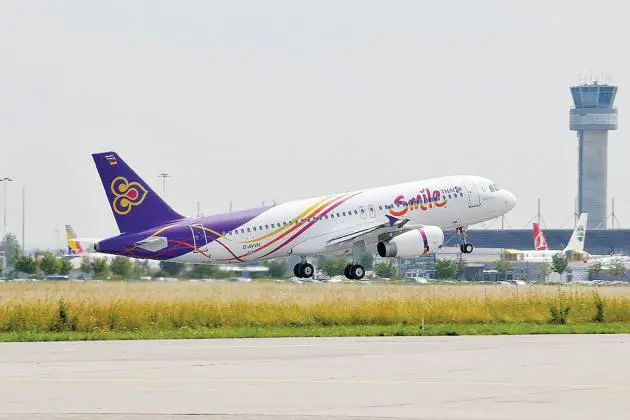


Play
TG 8929 took off from an Airbus base in Hamburg bound for Bangkok last Saturday at 12.38pm.
The new 174-seat aircraft carried just 30 passengers, excluding seven pilots and cabin crew. They were allowed to choose whichever seats they wanted.
Sounds strange – but this was no ordinary TG flight.
Shortly after in the plane was airborne, four cabin attendants, two of them in orange uniforms, started serving snacks, hot dishes, desserts and drinks. The airliner flew very smoothly to Bangkok via Dubai for almost 12 hours. A long, tiring flight, but apparently, all the passengers were in a happy mood.
And seemingly the happiest was Woranate Laprabang, managing director of Thai Smile, a business unit under Thai Airways International (THAI), the national carrier.
Welcome aboard the unofficial first flight of Thai Smile. This jet was the first Airbus A320-200 in its fleet, delivered last Friday in Hamburg. The firm has leased it from SMBC Aviation Capital of Britain for 11 years.
On its first official flight, it will travel from Bangkok to Macau this coming Saturday.
Thai Smile intends to have 11 aircraft in its fleet by next year and plans to increase this to 20 by 2015. By the end of this year, three new A320-200 jets will be delivered. This fuel-efficient aircraft is seen as ideal for cost-effective operation over the type of short-to-medium-distance routes the new airline will serve.
Thai Smile is intended as a tool to “protect and expand’’ the THAI network when the Asean Economic Community is fully implemented in 2015. By that time, the competition from city to city in the region will be more intense, according to Woranate.
Thai Smile’s position is not that of a low-cost airline, but as a sub-brand of THAI. It is an integrated part of THAI, not a separate entity or a different airline. Its code is TG, the same as THAI’s. It was created to serve the competitive market segment for more price-sensitive aviation services on some domestic routes and key cities in Asia, especially Asean, China and India, within a three-hour flight time from Suvarnabhumi Airport.
In addition, it will offer passengers ‘‘a trendy, friendly, and worthy service”, Woranate said, with its tickets priced 10-15 per cent lower than its sister airline’s. It aims for new travellers, especially younger people, tourists, businesspeople and government officials. Its advantage over rivals, especially low-cost airlines, is that its passengers can collect air miles under the same system as THAI.
“Thai Smile will not adopt a price-cutting strategy to compete with low-cost airlines,’’ he said. Instead, the airline will keep its operating costs as low as possible while maintaining service quality, safety and convenience.
Regional destinations will make up 70 per cent of the total. After Bangkok-Macau, new destinations will be added, including Danang, Mandalay, Luang Prabang, Siem Reap, Cebu, and Surabaya.
Domestically, it will replace some THAI routes out of Bangkok such as Krabi, Surat Thani and Udon Thani, which employ Boeing 737-400s. Also, it will promote its provincial base outside Bangkok, such as routes from Chiang Mai to Phuket to connect to other international cities.
This year, Woranate expects Thai Smile to earn Bt1.8 billion in total sales by flying to six destinations and Bt4.8 billion in 2013 with nine or 10 destinations. In terms of passenger numbers, it is expected to carry 300,000 by the end of this year and up to a million in 2013.
