
IMF is 'desperately optimistic' about global
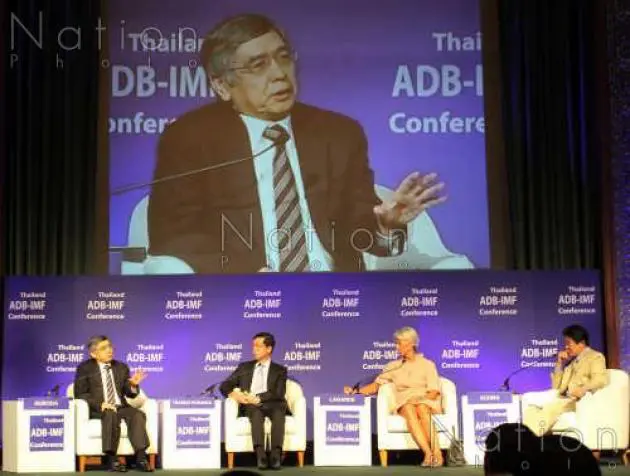


Christine Lagarde, managing director of the International Monetary Fund, said yesterday that she is "desperately optimistic" about the state of the global economy though Asia comes across as vibrant and buoyant.
The IMF, in its world economic report next week, will likely revise its global growth projection downward due to the risks in the US and Europe, she told the ADB-IMF conference on "Towards a More Stable Global Economic System".
In the US, a debate on the debt ceiling is heating up again, coupled with the "fiscal cliff" in which various tax cuts will expire and politicians do not want to make any decisions during this election period.
Another point of concern is the sovereign debt crisis in Europe, which is endangering the political and financial union process.
The financial markets have been applying pressure on European governments, which are having a difficult time restoring growth and also reducing deficits.
The discrepancies in the productivity of eurozone member economies have also created a structural problem that needs to be addressed.
Labour costs in Germany, the Netherlands and Finland, for instance, are higher or more competitive than those of the weaker economies such as Greece, Ireland or Portugal, said Lagarde, who is on a 10-day swing through Asia to gain firsthand experience in the economic and financial conditions, starting from Japan, Indonesia and Thailand.
Haruhiko Kuroda, president of the Asian Development Bank, said he is cautiously optimistic about developing Asia though this vast region is suffering a slowdown as a result of the euro crisis.
He projects Asia’s growth this year at 6.5 per cent compared to 7.2 per cent last year.
China and India are already facing an economic and export slowdown but both giant economies are in a strong position to weather the global economic crisis because they have large domestic markets.
China’s growth this year is projected at 8 per cent plus, while India should grow at 6.5 per cent.
More affected by the euro crisis are Southeast Asian nations, which are small, open economies. The region would not only be affected by the export slowdown but also by the volatility of capital flows.
Most Asean countries have opened up their capital accounts, which lets capital move in and out of their economies rather freely. China and India still restrict capital movement, making them less vulnerable to capital flight or flood.
Prasarn Trairatvorakul, governor of the Bank of Thailand, said the fact that Asia is interconnected with the global economy has posed challenges for policymakers over how they should cope with the global crisis and capital movements.
The financial crisis has forced policymakers in the developed nations to adopt unconventional and expanded tools, such as quantitative easing, which have now become conventional tools.
QE and other tools have complicated management of foreign-exchange reserves and economies in Asia.
A notable example of the complications is that euro deposit accounts at the Bank for International Settlements in Switzerland now yield negative interest rates, he added.
