
Beat rush into region, Thai firms urged
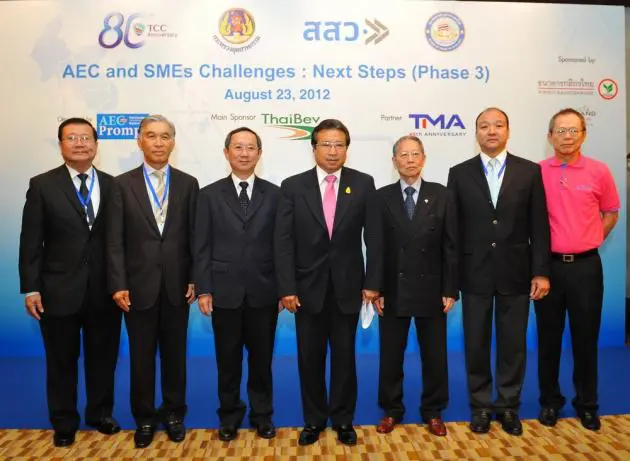


Small and medium-sized car-service operators, software firms and logistics companies are being urged to venture outside Thailand to seize the beachhead in neighbouring countries before they face greater competition on their home turf from foreign operator
At the "AEC and Challenges: Next Steps (Phase 3)" seminar, Industry Minister MR Pongsvas Svasti noted that Thai businesses had an advantage in that they are first to enter the neighbouring countries, which are not yet attractive to major foreign operators because of unclear regulatory rules and small market size.
Still, to prosper in the Asean Economic Community (AEC), Thai SMEs need to standardise their services and business operations, he added.
The minister said that for those who don’t want to venture outside, they should beware of greater competition from major foreign operators – particularly in the logistics sector – that will be drawn to Thailand by its geographical location in the centre of the region. With centres in Thailand, these companies can conveniently distribute products regionally.
This could spark takeover sprees, he admitted, adding that this could be tackled only with improvement in service quality and the introduction of distinctive marketing strategies.
"Thai operators have so far lagged behind in coming up with distinct strategies," he said.
According to Pongsak Assakul, chairman of the Thai Chamber of Commerce, the Thai government should take the lead in streamlining the competition laws, which differ in detail from country to country. Urging that this streamlining take place before the AEC’s activation in 2015, he said different definitions of competition and regulations could post obstacles to cross-border investment.
He also fretted about anti-dumping rules once a large volume of Thai products hit these countries.
Pongsak said about 70 per cent of Thai SMEs were aware of the AEC, compared with zero three years ago. Yet they are in the dark on how to cope with the regional integration, and this requires collaboration from all parties to prepare SMEs over the next two years. Without help, they won’t be able to reap the benefits, as happened with the Asean Free Trade Area (Afta), the chamber chairman said.
He added that so far, few SMEs had been able to benefit from Afta because of lack of knowledge about rules on origins of products.
According to the Office of Small and Medium Enterprise Promotion (Osmep), of about 3 million Thai SMEs, 975,552 – or 33 per cent – are service-oriented. They employ 3.46 million workers, or 35 per cent of the total workforce in the SME sector. These service companies generate Bt2.37 trillion, or 26 per cent of the country’s gross domestic product.
Osmep deputy director-general Vimolkarn Kosumas said the office was planning to help them on business networking and matching, as well as training in regulations that could affect their operations.
A study by the office covering three service industries showed that the hotel and restaurant industries would not be affected by the AEC in the near term, but would face competition from foreign competitors later. Thailand’s healthcare service industry stands to benefit from the AEC, but the bigger market will draw foreign investors, which could force mergers and acquisitions.
The study found that Thai companies in the logistics industry were in a worrisome state. Thai shipping agents in particular show low competitiveness, while foreign competition is expected in the warehousing and storage segments.
