
Deals boost ability to pay back much of pledging budget
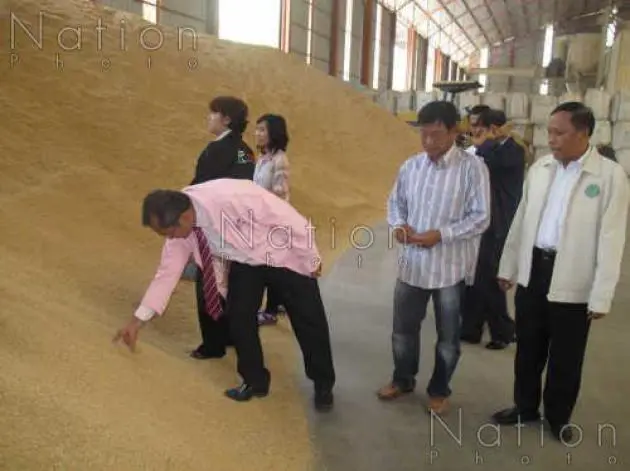


The Commerce Ministry has promised to pay back the government at least Bt275 billion next year from the budget allocation for financing the rice-pledging scheme, as it is confident sales of 8 million tonnes under government-to-government rice deals can be
The forecast income is lower than the overall budget of Bt282 billion that has been spent to subsidise rice cultivation for both the main and second crops over the past year.
It was reported that the ministry had informed the commerce minister that the government had already signed contracts for the sale of 7.328 million tonnes of rice to six countries, including China, Bangladesh and the Philippines, under G2G deals.
However, Commerce Minister Boonsong Teriyaphirom yesterday declined to disclose details of the contracts, particularly prices, saying only that satisfactory prices had been reached between Thailand and its trading partners.
The ministry has said it will be able to sell its remaining rice stock of 4.17 million tonnes next year. However, the government also announced a price-pledging programme for second-crop rice, under which 6.208 million tonnes of paddy will enter the government’s warehouses soon.
This year, the ministry is expected to generate about Bt85 billion from rice sales, while the remainder of the Bt275 billion will be generated next year.
Speaking during the ministry’s announcement of its performance over the administration’s first year in office, Boonsong said the project to boost farmers’ incomes had been one of the most successful of the ministry’s schemes as rice prices had increased gradually during the past year.
The minister hit back against the many critics of the pledging project, who claim that it has damaged the market mechanism and rice-export efficiency.
He reaffirmed that Thailand this year would be able to export 8.5 million tonnes of rice, of which 6.5 million tonnes would be shipped by exporters, with the government shipping at least 2 million tonnes under its own contracts.
The average price of white paddy rice was quoted at Bt7,600-Bt8,700 before implementing the subsidy, whereas the price now is Bt9,000-Bt10,800, he said. Paddy jasmine rice, meanwhile, has risen from Bt12,450-Bt13,500 per tonne to Bt14,750-Bt16,000.
“Those government-to-government contracts are not just memoranda of understanding. There are real trading agreements, which Thailand and its partners are quite satisfied with in terms of the trading price,” said Boonsong.
Moreover, he said, the government has released 797,000 tonnes of rice to other government agencies, and sold 264,000 tonnes to private traders under the bidding process. As a result, only 4.175 million tonnes remain in the government’s stocks.
With a relatively small stock, Boonsong said the government did not need to rush into releasing rice from its warehouses, as it wanted to keep the produce for security reasons amid an expected slowdown in exports by India and the United States.
The ministry also reported that it had spent Bt359.16 billion on farm-subsidy projects during the past year. Of this total, Bt282 billion was spent on rice, Bt28.25 billion on cassava and Bt15 billion on rubber.
Overall export target still in place
Meanwhile, Boonsong said the ministry would not adjust its official 2012 target for overall export growth of 15 per cent, even though exporters would be unable to achieve such a challenging goal.
Lowering the target could damage the spirit of those involved in trying boost exports this year, he said. However, he added that it would be missed because of the severe impact of the euro-zone crisis and the effects of last year’s flooding on the country’s industrial sector earlier in the year.
The ministry is confident that inflation will be kept under control at between 3.3-3.8 per cent this year, thanks to the government’s measures aimed at reducing the cost of living, he said.
Despite rising fuel prices and current flooding in the North, inflation should not exceed 3.8 per cent this year, Boonsong said.
