
Rice scheme 'good for a few years'


Thaksin defends controversial programme
Former PM Thaksin Shinawatra voiced support yesterday for the government's controversial rice price-pledging programme, saying it should be extended for several more years.
He rebuffed critics who say the policy has increased public debt, encouraged corruption, distorted the market and eroded Thailand’s position as a leading rice exporter.
Observers saw the comments as the fugitive ex-leader’s latest bid to influence Thai government policies from overseas.
Prime Minister Yingluck Shinawatra implemented the price-support policy to boost incomes of farming families whose support helped Pheu Thai Party win the election last year. The programme, under which the government buys rice from farmers at well above market rates, reaps economic gains that are about three times the programme’s cost, Thaksin claimed in an interview in Singapore.
“If we manipulate the mechanism for two years, three years, then things will be moving naturally,” Thaksin said. “The rice price in the world market is increasing.
“We do not just throw away the money,” Thaksin said. “The programme will lead to higher government revenue through the sale of stockpiled grain, increased local consumption and will help cushion Thailand from the effects of the European debt crisis,” he said.
Despite increasing corruption complaints over the programme, Prime Minister Yingluck will chair a National Rice Policy Committee to consider new lending totalling Bt405 billion to back the over-the-market subsidy scheme in the 2012/2013 harvest season.
Commerce Permanent Secretary Yanyong Phuangrach said yesterday Yingluck had ordered the committee meeting, which she will chair after returning from the US.
The Office of Agricultural Economics (OAE) yesterday said total rice production under the state rice pledging scheme would reach 50 million tonnes of paddy, including pending stockpiles in government warehouses.
OAE secretary-general Apichart Chongsakul, said main crop production had reached 25 million tonnes, a slight drop from its previous projection of 26 million tonnes. A second crop accounted for 11 million tonnes. As a result, paddy rice entering the market next year would reach 35-36 million tonnes.
However, the figure is different from a Commerce Ministry report released last Friday, which said total production would reach 34 million tonnes for the main crop and 13.3 million tonnes for the second crop next year.
Apichart said the different figures derived from overlapped production of the second crop. To solve the problem, the government had changed its criteria for the rice pledging scheme by reducing it to only two times a year, by limiting more of the out-of-season harvest (which meant the second crop would be pledged only once).
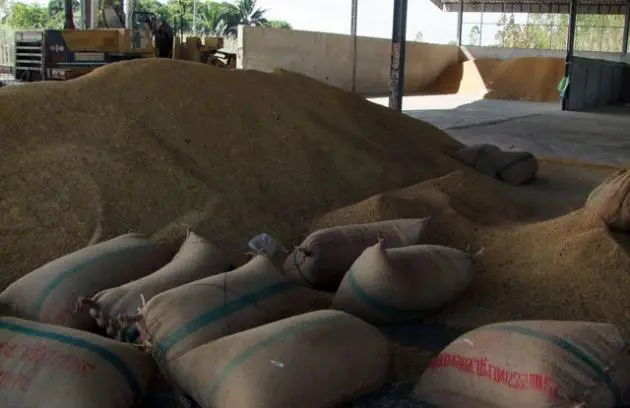
The office also warned that the government’s huge stockpile of 16-17 million tonnes of paddy should be released soon, or total rice production would reach 50 million tonnes.
The government has spent Bt282.5 billion since October buying about 18 million metric tonnes of unmilled rice from 2.45 million farmers at above-market rates, according to the Ministry of Commerce. Spending may increase by a further Bt405 billion in the fiscal year starting October 1, as the government wants to buy as much as 34 million tonnes, Commerce Minister Boonsong Teriyapirom said last Friday.
“This may help consumer spending to remain well-supported and expansionary fiscal policy may add momentum to growth,” said Enrico Tanuwidjaja, an economist at the Royal Bank of Scotland in Singapore. Thailand’s fiscal deficit may expand to more than 2 per cent of gross domestic product next fiscal year, from 1 per cent, because of the rice scheme, he said.
State purchases will boost stockpiles of milled rice from the annual harvest that starts next month to a record of 12.1 million tonnes and may reduce Thailand’s exports this year by 39 per cent to 6.5 million tonnes, less than India and Vietnam, according to the US Department of Agriculture.
Thaksin said the government had 17 million tonnes of paddy on hand, and stockpiles of milled rice were estimated at 4 million tonnes. Sales to Indonesia, Iraq and Ivory Coast, as well as other countries in the Middle East and Africa, would keep reserves down, he said.
“I don’t think we have much because we keep selling,” he said, referring to the stockpile next year.
Thailand’s October harvest accounts for about 70 per cent of total output, and a secondary crop is harvested through to July. The United Nations’ Food and Agriculture Organisation said in August Thailand should be able to retain its position as the world’s top exporter, shipping 7 million tonnes this year.
Shipments at that level would mean that Thailand was still number one, but with a better price, Thaksin said. “If we were to push our selling to compete with India when they started dumping rice …. we’ll probably end up at $400 per tonne. Now it’s $602. We will be doing OK.”
The government is targeting exports of 8.5 million tonnes this year, boosted by sales to China, Bangladesh and Indonesia. Sales tumbled 45 per cent to 4.75 million tonnes for the year to September 18, according to the Thai Rice Exporters Association.
Thaksin said the previous government spoiled exporters by selling them cheap rice and called on them to get better at marketing. About 40 per cent of Thailand’s 67 million people who depend on rice farming were satisfied with the policy, he said.
Total losses from the scheme are estimated at about Bt60 billion a year, based on a purchase cost of about $660 a tonne, Thaksin said. “We don’t lose that much,” he said.
The cost could rise to Bt200 billion after accounting for losses and storage fees for the grain, Kiat Sittheeamorn, an opposition parliamentarian, said last month.
An income-support programme implemented by the previous government, headed by now-opposition leader Abhisit Vejjajiva, provided about Bt67 billion in direct payments to 4 million rice farmers in the 2010-2011 production year, according to the state-run Bank for Agriculture and Agricultural Cooperatives.
A poll by the University of the Thai Chamber of Commerce in July found 86 per cent of 1,200 farmers surveyed said price-support moves were needed because of high production costs and low prices.
“Please sympathise with them,” Thaksin said of the farmers. “They are poor. Let them have a chance to survive in this world, to live a better life.”
