
Green strategy dominates Tesco Lotus expansion
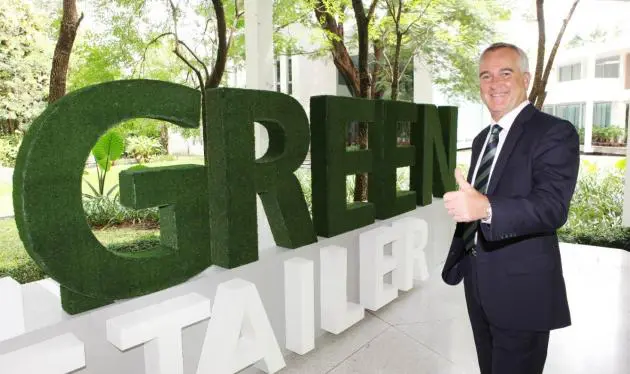


Tesco Lotus is spending Bt1.2 billion this year on green initiatives amid uninterrupted efforts to expand its business network through all possible store formats.
“We have deployed various carbon-reduction initiatives, including innovations such as the first zero-carbon store in Asia. This year, we have allocated an additional Bt1.2-billion budget, of which Bt920 million has already been invested in new store designs and other energy-saving initiatives in our business operations,” chief executive officer John Christie told a news conference yesterday.
“We have lined up high-impact campaigns to stimulate green shopping habits while continuing to engage staff and communities in combating climate change,” he said.
Tesco Group aims to reduce its global carbon emissions by at least half by 2020. In Thailand, that will be equivalent to a reduction of 160,000 tonnes.
Launched in 2006, the green journey has cut carbon-dioxide emissions by more than 30 per cent. The focus now will be the reduction of that gas involving distribution and business operations as well as the instilling of green habits among consumers.
The green initiatives are continuing, as Tesco Lotus is expanding aggressively in Thailand.
The company recently committed to selling five more properties to the Tesco Lotus Retail Growth Freehold and Leasehold Property Fund for Bt7.55 billion.
The proceeds will be partly used to open stores and refit some branches, some of which are more than 10 years old, Christie said. Some proceeds will be used to build a few distribution centres to help reduce delivery times to outlets nationwide and to complement the green initiative to cut transport-related fuel consumption.
“The Northeast is a significant part of the country, which offers opportunities,” he said. “Country by country, year by year, the challenges [in the retailing industry] differ. But the key is to make customers happy, with better service, quality and store size. We have to be fast, listening and reacting.”
The company has witnessed success with the larger “Extra” format. Starting with the outlet on Rama IV Road in Bangkok, it opened the next one in Bang Na district this year and four more will be completed this year. Next year should see Extra reaching 10 units, thanks to the bigger size and ability to offer one-stop shopping for customers.
“We’d like to do more, as it’s very successful … because of the changing lifestyle,” he said.
Having a variety of formats will help the company capture all types of customers.
To cash in on standalone stores, a few months ago Tesco Lotus launched the Assign fashion store. There could be three or four Assign stores this year, if the pilot project is successful.
Small hypermarkets will also be its focus to serve customers who often shop on the way back home from work. Plus, small stores are easier to establish, because of the opening of more shops and the increasing difficulty in finding locations for big outlets.
Competition in the retail industry is already tense, with new players in the market, but “competition is good, healthy and good for customers”, Christie said.
