
BlackBerry 10 to be launched on January 30, new devices in Q1
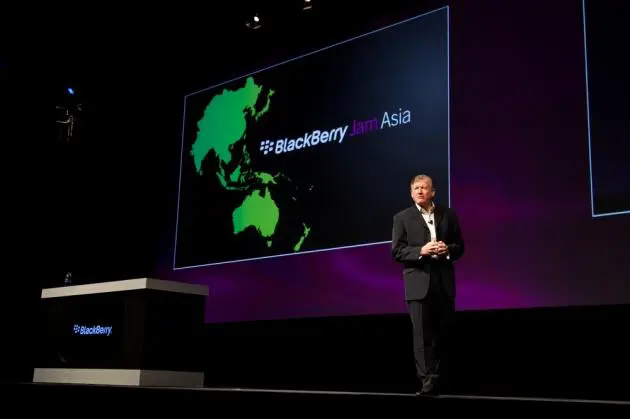


Play
Research in Motion (RIM) will launch the BlackBerry 10 operating system on January 30, with BlackBerry 10 devices coming on stream within the first quarter, the company announced today at its "BlackBerry Jam Asia" event in Bangkok.
Urpo Karjalainen, senior vice president and regional managing director for RIM Asia-Pacific, said BB10 was a completely new platform.
“January 30 is the day we make the global launch. Then there will be BlackBerry 10 devices in some selected markets,” Karjalainen said. “Then, we will launch two types of full-touch devices with QWERTY keyboards.”
Existing BlackBerry devices will not support the BB10 operating system, but users can transfer the content of their old BlackBerry into a new device.
“They can transfer their contacts, content and information from the old device to the BlackBerry10 device,” Karjalainen said.
He added that BB10 platform and the new devices using the new OS were important for the success of BlackBerry.
“BlackBerry Jam is an important milestone for us to build and to engage applications for the BlackBerry 10 platform,” he said. Applications from the Android platform would be transferred to BB10.
He said that after BlackBerry 10 was launched, there would be more than 100,000 applications available for it.
“Thailand is an important market for RIM, and it aims to gain more market share here. The challenge is that Thailand is a competitive market. We have plans to increase our share of the Thai market but we cannot disclose them yet.”
He added that RIM would focus on both the enterprise and the consumer market. The BlackBerry10 devices, which are expected to comprise several models, will satisfy users in both work and personal use, he said.
Four main features differentiate BB10 from previous BlackBerry operating systems.
First is BlackBerry1 Hub, which that allows users to integrate their contacts, calendar, e-mail, and social apps such as Twitter, Facebook, LinkedIn and Foursquare.
Second is a “writing without typing” keyboard, smart software that learns the way users employ language in context.
“It is the first time that typing on a touch screen will be faster than on a QWERTY keyboard. It is not about prediction. It is intelligent software developed to learn people’s language. It will support many languages, including Thai,” Karjalainen said.
The third interesting feature completely separates “work” and “personal” modes on the same device. It is easy to switch between the two, isolating the device from the enterprise’s server when it is in “personal” mode.
The last feature is that BlackBerry10 does not have any buttons, not even a “home” key.
“It still has an ‘on’ switch and a camera button on the side,” Karjalainen said.
