
Cut in personal income tax due


Play
Move to benefit lower, mid-income earners; Bt25 bn annual loss to be offset by bigger tax base: Kittiratt
The Cabinet yesterday gave taxpayers a big Christmas present by cutting their personal income tax rates for next year, although the top rate will remain high at 35 per cent, down only slightly from the current 37 per cent.
“The tax cut will result in a government revenue loss of Bt25 billion annually, but it leaves more money in people’s pockets, which should lead to more consumption and boost the economy in the long run,” Finance Minister Kittiratt Na-Ranong said in the tax package his ministry submitted for approval.
“This move is to ensure fairness to low-income earners,” said Kittiratt. He insisted that overall tax revenue will be unaffected by the move, which will cost the government Bt25 billion per annum, as the corporate income tax cut this year had in effect expanded Thailand’s tax base.
“It’s clear that the tax base has been expanded by the corporate tax cut. As such, we can lower personal income tax. As GDP expands, the number of income earners rises, and Thailand enjoys a low unemployment rate. Overall, the government revenue will not be cut,” he said.
Overhauling the personal income tax structure was one of the Yingluck Shinawatra government’s key election promises. It takes effect a year after the government slashed the income tax rate for businesses, and to complete the tax reform, the excise tariff for vehicles will be revised to show Thailand’s commitment to reducing carbon emissions.
Baker & McKenzie chairman Kitipong Urapeepatanapong said the move would not result in a huge decrease in revenue for the state, especially compared with the government’s populist first-car policy, on which a large amount would be spent, or with earlier tax reductions.
“For example, those earning more than Bt4 million a year are entitled to a 2-percentage-point decrease, from 37 per cent to 35 per cent, which is very little for them,” he said.
Those earning Bt150,001-Bt300,000 a year, who will be entitled to a 5-percentage-point decrease, will benefit most, while those earning the most would not benefit as much, as they could enjoy other tax incentives such as for home purchases as well as discounts on their insurance.
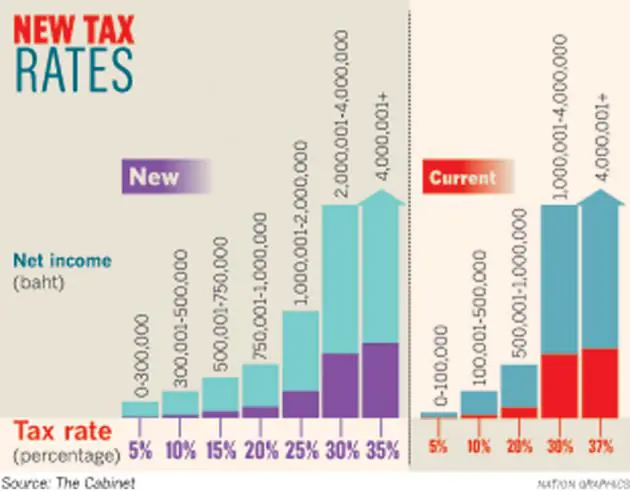
Unlike corporate income, personal income is subject to progressive tax rates, but tax brackets will be increased to seven from five currently.
Under the new tax table, taxable income up to Bt300,000 will be taxed at 5 per cent, half of 10 per cent currently. However, the first Bt150,000 will still be exempt from taxation.
The Bt300,001-Bt500,000 bracket will be subject to 10 per cent, the Bt500,001-Bt750,000 bracket to 15 per cent, down from 20 per cent currently, and the Bt750,001-Bt1 million bracket at 20 per cent, the same as the current rate.
The rate for Bt1,000,001-Bt2 million will be 25 per cent, down from 30 per cent currently, for Bt2,000,001-Bt4 million will be 30 per cent and for income greater than Bt4 million will be 35 per cent.
Economists have long argued for a lower government tax base. Tax collections account for about 16 per cent of gross domestic product now, while it should be more than 20 per cent of GDP. The government this year slashed the corporate income tax from 30 per cent to 23 per cent and plans to drop it further to 20 per cent next year.
They also worry about budget deficits, as the government has launched many populist schemes that might lead to a public debt crisis in the future, as seen in the US and Europe now.
The Cabinet also approved new tax rules allowing a husband and wife to file separate
tax returns, which will result in a lower tax burden for the family. It will take effect immediately.
The move brings the Revenue Code into compliance with the Constitution Court’s ruling against the Revenue Department’s requirement for a wife to add her income to her husband’s for filing a joint return, resulting in higher tax payment than filing individual returns.
The new rule will result in a government revenue loss of Bt7 billion a year.
The Cabinet also gave the nod to reforming the excise tariff for vehicles in 2016, giving carmakers time to adjust.
The new tariff is designed to curb carbon dioxide (CO2) emissions by automobiles, said Kittiratt, also a deputy prime minister.
Lower CO2 emissions will enjoy a lower tax rate.
Hybrid electric vehicles are obviously the winner under the revised structure.
For example, hybrids with engine capacity of no more than 3,000cc that release no more than 100 grams of CO2 per kilometre will be taxed at 10 per cent.
For ordinary passenger cars up to 3,000cc releasing no more than 150 grams, the tax rate will be 30 per cent.
Small cars powered by natural gas for vehicles or ethanol that issue no more than 150 grams will deserve a 25-per-cent tax rate.
