
Regional debt markets need development, says S&P


Play
Capital markets in Southeast Asia can better retain and mobilise the high savings rate and government reserves within the region by further developing their local currency bond markets and improving intra-regional investments, said Standard & Poor's Ratin
Meanwhile, Moody’s Investors Service says sovereign credit fundamentals in Southeast and South Asia should remain relatively resilient to headwinds during 2013, but warned that each country would face its own specific problems.
According to the S&P report, titled “Keeping It in the Family: Why Asean Debt Markets Need Greater Regional Investor Participation”, local investors currently prefer to invest in their respective markets – or further afield, in the US or Europe – than in neighbouring countries.
“The economic outlook for Asean remains relatively bright, especially in light of the difficulties facing other parts of the world,” said Surinder Kathpalia, managing director for Asean at Standard & Poor’s. “We forecast real GDP growth of 4 per cent to 6 per cent for Southeast Asia’s major economies of Indonesia, Malaysia, the Philippines, Singapore, Thailand and Vietnam in both 2013 and 2014.”
Savings exceed investments in aggregate across Asean currently, indicating an opportunity exists for the region to better retain savings and surpluses within its borders and meet financing requirements for massive infrastructure projects and development to support the region’s surging population.
According to a study by Asian Development Bank in 2012, gross national savings of Asean countries (estimated at 30 per cent of GDP) exceeded domestic investments by 5 per cent to 10 per cent of GDP.
“Asean capital markets are among the fastest-growing around the world and are drawing increased attention from investors abroad. But more can be achieved to finance the region’s economic development and growth ambitions,” Kathpalia added.
He said Standard & Poor’s recent expansion of its Asean regional credit rating scale to more than 120 issuers is aimed at strengthening the credit culture in the region. The Asean regional credit ratings provide independent opinions about the credit risk of issuers active in Southeast Asia relative to others in the region, Kathpalia said, adding that the regional scale also expands the investable universe from strictly domestic investment opportunities to regional ones, thus helping to mobilise the deep savings pool within Asean.
Moody’s conclusions were contained in three newly released outlooks authored by its analytical teams in the region for Asia Pacific’s sovereigns, corporates and banks over the course of 2013.
“For Asia Pacific as a whole, Moody’s expects sovereign credit profiles to withstand the risks related to the headwinds to global growth, given solid macroeconomic fundamentals and an increasing reliance on domestic sources of growth,” says Christian de Guzman, a vice president and senior analyst with Moody’s Sovereign Risk Group.
“The region will continue to grow faster relative to other regions, and growth in China – a key factor – will moderate with no hard landing,” says de Guzman.
Mid-size economies
Durable domestic demand will likely sustain stronger growth in a number of mid-size economies in the region. Household consumption will continue to drive momentum in Indonesia and the Philippines, while sizeable public investment programmes in Malaysia and Thailand could offset the vulnerabilities from their reliance on international trade.
Meanwhile, the ongoing pursuit of growth-enhancing opportunities in a number of frontier markets in the region, including Bangladesh and Myanmar, may require increasing global market financing in 2013.
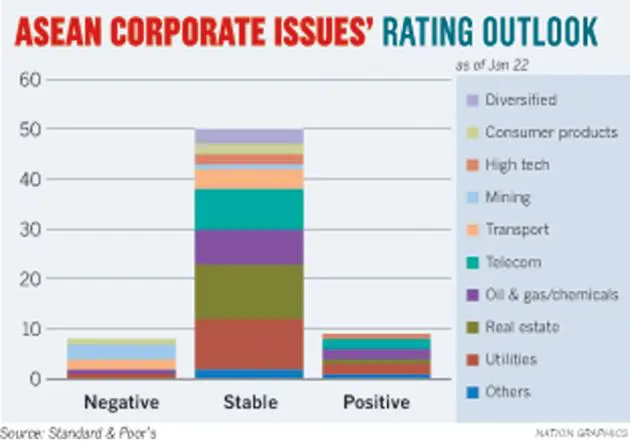
“With the corporate sector, the credit quality of Southeast and South Asian corporates overall will remain stable, but export-oriented companies, firms in the commodities industry, and those exposed to cyclical sectors will be vulnerable to the sluggish economic growth apparent in the major developed markets, and to China’s lower plateau for GDP growth,” says Simon Wong, a vice president and senior analyst with Moody’s Corporate Finance Group.
The report identifies the most vulnerable sectors as coal mining (negative); shipping (negative); consumer electronics and semiconductors (negative); and, to a lesser extent, refining and marketing (stable); and steel (stable). For the corporate outlook for Asia (ex-Japan), Moody’s expects downward rating pressure to ease in the next 12 months, given stabilising economic growth in China, manageable refinancing risks and expectations of continued accommodative monetary policies.
However, negative rating actions will continue to outpace positive ones, although to a smaller extent, because the weak growth in the developed markets and the lower plateau for Chinese economic growth will continue to pressure Asia’s export-oriented corporates and those in cyclical sectors with structural overcapacity.
For the banks in the region, the broad credit outlook is stable on the expectation that they will remain largely insulated from the negative credit pressures affecting their peers in many Western economies.
“We consider that this stable outlook is driven mainly by the region’s economic resilience; its relatively accommodative monetary policy; and the banks’ own strong liquidity when compared to global norms, as well as their relatively robust capital buffers,” says Stephen Long, the managing director for Moody’s Financial Institutions Group in Asia Pacific.
