
Genuine fiscal discipline essential in holding down debt-to-GDP ratio


Play
Spending plans might push public debt to 60 per cent of GDP by 2015
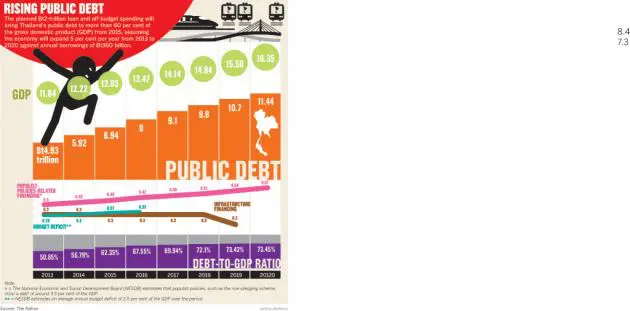
Despite the government’s insistence that it would maintain fiscal discipline, the Bt2 trillion it intends to borrow for its infrastructure development programme will push Thailand’s public debt past 60 per cent of gross domestic product from 2015.
This is based on the assumptions that the economy will expand 5 per cent on average per annum from 2013-2020 and that the government will borrow Bt300 billion a year to finance the infrastructure projects throughout the period, in light of the continuation of some populist policies and a huge off-budget financial burden.
In the worst-case scenario, based on The Nation’s calculation, when all on- and off-budget borrowings are accounted for, starting from 2015, the public debt will exceed the threshold of 60 per cent of GDP.
The National Economic and Social Development Board estimated that populist policies, including rice-pledging schemes, would create a debt burden of about 3.5 per cent of GDP during the period.
According to MR Pridiyathorn Devakula, former deputy prime minister, the government is set to spend another Bt60 billion as tax rebates to car buyers under the first-car buyer scheme. (About 700,000 units bought under the scheme will be delivered this year. Owners cannot claim tax rebates until they own the vehicles for more than a year.) It is also expected to clear the Bank for Agriculture and Agricultural Cooperatives’ debt, incurred by the government’s public-service projects, worth Bt199 billion. Another Bt100 billion will be required for the recapitalisation of state-owned financial institutions.
Meanwhile, on off-budget financing, aside from the Bt2-trillion infrastructure borrowing, the government is set to raise another Bt400 billion to finance the Bt350-billion water-management plan and the Bt50-billion disaster-insurance fund.
Adding all this to the budget deficit of Bt300 billion in 2013, if all borrowing plans are kicked off, the ratio of public debt to GDP will rise to 50 per cent this year. And the ratio will only swell, eventually passing 70 per cent in 2020 when the Bt2 trillion will be fully reimbursed.
There are three ways to reduce the ratio:
_ the economy must expand by more than 5 per cent per annum;
_ the government sets aside a larger amount for debt repayment in the next years;
_ it slashes some spending plans.
On economic expansion, the outlook seems uncertain. Since 2012, domestic demand has been the major driving engine thanks to stimulus policies, while the export sector, which contributes 70 per cent to the GDP, is reeling under unfavourable global factors. Chief among them is the euro-zone public debt. The concerns were stabilised in the past year, only to flare up this year with a tiny hiccup from a tiny island – Cyprus. Global investors are on full alert, witnessing the huge impact from the small island on the euro zone. This raises the possibility that the euro zone will eventually break up. Given that one-fourth of global trade is denominated in the currency, such a break-up would cause global chaos.
Despite some improvements in the United States, the International Monetary Fund is reportedly mulling lowering the growth forecast from 2 per cent to 1.7 per cent in 2013 because of higher taxes and spending cuts. Meanwhile China, under its new leadership, is expected to show 8-per-cent growth this year, amid pressure for reforms at home and internationalisation of its currency.
Under these circumstances, will Thailand’s domestic demand – to be boosted by the infrastructure investment – be strong enough to shield the economy from external headwinds? Will the investment boost GDP growth by another percentage point during the seven-year period as promised by the government?
Can the government accelerate debt repayment? This is a slim possibility. In the 2013 fiscal year, Bt49 billion or 2.1 per cent of the budget is set aside as principal repayment, up by Bt2.29 billion (2 per cent) from the previous fiscal year. Notably, fixed expenditure in the year accounted for 80 per cent (Bt1.9 trillion) and investment 18.7 per cent (Bt449 billion).
Based on Deputy Prime Minister Kittiratt Na-Ranong’s remark that during the seven-year period the combined investment budget would reach Bt2.2 trillion, it does not look possible that the ratio of principal repayment will rise fast enough.
In this case, the last option seems the most possible. The government should assure all that it will not launch any unnecessary spending plans – like the first-car-buyer scheme. Meanwhile, some existing schemes must be dropped, primarily the rice-pledging scheme, which incurred a loss of more than Bt100 billion in the first year. Without considering this option, Kittiratt’s insistence of a low debt-to-GDP ratio will turn out to be just another “white lie”.
