
BOT 'should move to long-term bonds'


The Bank of Thailand should replace short-term bonds with zero-coupon bonds with longer maturity to kill the "Trojan horse" that is inflating the baht, said Kasikornbank's chief economist.
Kobsidthi Silpachai, KBank’s capital markets research head, said that as the central bank’s Monetary Policy Committee was reluctant to cut interest rates, longer-maturity/zero-coupon bonds would drive away speculators who are making quick profits through the carry trade.
Zero-coupon bonds do not pay interest.
In his view, this would raise transaction costs. Hedge funds would need to sell such bonds sooner than maturity if they wanted to unwind their short US dollar/baht positions. By issuing longer-dated bonds, the BOT would force hedge funds to hold them longer unless they were willing to sell the issues in the secondary market and expose themselves to bid/ask spreads and duration risks.
“We view that such a move would be effective in quelling volatile capital flows, as it would prevent that Trojan horse from ransacking Thailand’s export competitiveness,” he said.
After issuing Bt7.8 trillion worth of bonds last year, last month the BOT issued bonds worth Bt500 billion, with maturities ranging from 14 days to three years.
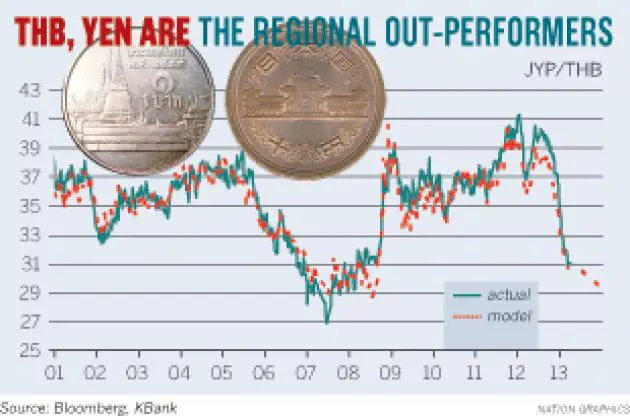
The baht is outperforming regional currencies, gaining more than 5 per cent this year against the US dollar, compared with 3.2 per cent in all of 2012. The currency, which spiked to the strongest level of 28.89 on Wednesday, slightly weakened yesterday to 29.03 as of 3pm.
In the process of foreign-exchange intervention and sterilisation, speculators now sell dollars for baht. The central bank issued short-term bonds to absorb the dollar, in effect funding the dollar/baht long position. Speculators end up as some of the buyers of these bonds.
Kobsidthi attributed the Bt1 appreciation to 30.70 per dollar in the first quarter of 2012 to hedge funds’ Bt125-billion bond purchase. Likewise, in the first quarter of this year, the Bt86-billion purchase caused the baht to shed another Bt1.40 to 29.19.
“The flawed process of FX intervention and sterilisation is reminiscent of the Trojan horse in the form of the Bank of Thailand’s own instruments; for example, BOT bonds,” he said.
He said short-term bonds were like holding cash, as they showed no interest-rate risk and were very liquid. Hedge funds can join the auction to purchase the bonds, and simply wait for a few days to sell them. Without need to depend on the secondary market, they pay little transaction cost.
Money supply in the “Group of Three” – the European Union, the United States and Japan – has swelled because of monetary easing.
KBank estimates that if the European Central Bank stays pat on printing while the US Federal Reserve and Bank of Japan continue, their M1 money supply will swell to US$16.5 trillion (Bt479 trillion), inadvertently bloating the East Asia ex-Japan central-bank balance sheet to $5.8 trillion. These monies are flowing to emerging markets for higher returns.
Meanwhile, the Fiscal Policy Office said there remained the monetary space to stem the baht’s appreciation, while the BOT is closely monitoring foreign-capital movements, asking foreign brokerage houses to report in detail capital inflows to Thailand, said Somchai Sajjaphong, director-general of the FPO.
“We must not employ any measure that ignites market panic. Tax measures will be the last resort, as they could cause more damage than benefits and would [adversely] affect confidence.”
However, Association of Investment Management Companies (AIMC) said that the Bank of Thailand has not made a request for details of foreign investment through it, disclosing that foreign investment through funds was worth about Bt150 billion with less than 20,000 foreign investors, in 2012.
Thawatchai Lueangsurarangsee, deputy director at AIMC, said that of total foreign investment made through funds in 2012, about Bt9 billion were invested through equity funds, Bt25 billion through fixed income funds, Bt1.5 billion through mixed funds, and Bt14 billion through property funds.
Most foreign investors made investment through commercial banks’ subsidiaries. Of total foreign investors, about 4,700 made investment through SCB Asset Management, 4,700 through Bualuang Asset Management, 4,000 through Kasikorn Asset Management, 1,600 through TMB Asset Management and 1,000 through Aberdeen Asset Management.
The top five for foreign investment in 2012 were: Krung Thai Asset Management with foreign investment of Bt92 billion, Bualuang Asset Management with foreign investment of Bt12 billion, K-Asset with foreign investment of Bt10 billion, SCBAM with foreign investment of Bt10 billion and MFC Asset Management with foreign investment of Bt10 billion.
