
Rayong streetcar to expand


Play
Entering its sixth year, a motorised streetcar service in Rayong's Klaeng municipality has proven a success as a small mass transit line, which would be turned into a real rail-based system in the near future pending studies.
The service, now comprised of five cars running on liquefied petroleum gas (LPG), is popular among locals for daily commuting and visitors chartering the cars for city tours, mayor Somchai Jariyacharoen said.
<iframe width="560" height="315" src="http://www.youtube.com/embed/660utRbvXOg" frameborder="0" allowfullscreen></iframe>
There are four routes serving about 450 passengers each day, while saving some 7,250 litres of oil and 16 tonnes of carbon dioxide emissions yearly. The latest car to be deployed can lift wheelchairs at the rear and carry five of them while still reserving space for many passengers. A trial that operated the cars on electricity proved to be expensive, at Bt300,000 per 60 kilometres, before the current operation relying on a mixture of petrol and LPG was chosen.
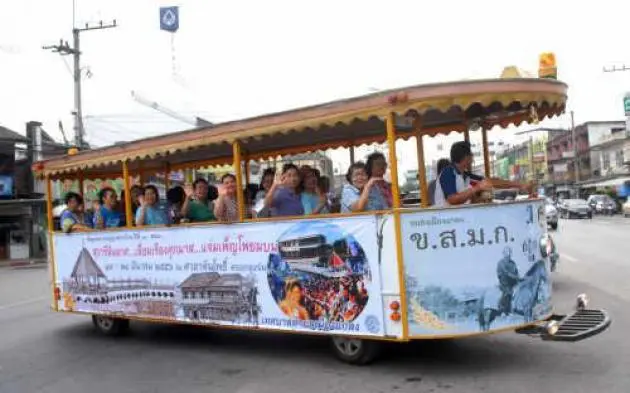
Each car, which weighs three tonnes with a payload of 1.5 tonnes, is built on a chassis with a classic-looking passenger compartment on top, resembling real streetcars that run on rails. Each unit costs Bt850,000, with the fifth that can lift and carry wheelchairs produced for Bt950,000. The managing director of Rod Rang Chom Mueng Sukhothai Co, which builds the units for Klaeng and other buyers, said his father designed the streetcars based on the model that ran on Bangkok streets during King Rama V’s reign. Such commuter streetcar services were seen in many municipalities in several provinces, including Sukhothai where the firm is based.
The service is also provided in Ayutthaya and will soon be available in municipalities in Nan, Chiang Rai, Phayao, Phrae and Nakhon Ratchasima. Now the company’s business is sort of family-run, which can roll out a car every three months, and will be upgraded to an industrial level in the near future.
The two groups using this streetcar the most are the elderly and people exercising at public parks, and students travelling downtown. The cars run three shifts – 7-7.30am, 3.30-4pm and 4-6 pm – every day except Sunday.
Many parents use motorcycles or cars to drop their children off at a train stop, instead of driving them to school.
Somchai said the attraction of this service was its great comfort, and travel at slow but relaxing speeds, while the high roof and unblocked sides gave passengers the feeling of taking a city tour.
Ratthaphol Charoenruay, a senior administrative chief, said the streetcars could not yet be registered with the motor vehicle service, which is the only setback associated with the service. A car can carry 50 passengers and travels at an average speed of 12-18 kilometres per hour, taking 15-35 minutes to run a route.
The 5km student route sees about 180 riders during the morning and evening rush hours, while the normal route between the main stadium and downtown , a distance of three and 13kms, sees 140-200 riders per day.
Soithip Traisukhont, a former official of the Office of Transport and Traffic Policy and Planning under the Transport Ministry and now a deputy permanent secretary, praised the Klaeng streetcar service, saying it set a good example for other administrations.
The office is even studying this model and working on promoting it at other local administrations.
