
Escap predicts subdued growth


Play
Thailand, together with many other Asia-Pacific economies, is expected to see subdued growth after last year's sharp slowdown caused by external factors, especially the fiscal crisis in the euro zone and policy uncertainty in the US, the United Nations E
“A cautious factor for Thailand is the inflow of short-term capital, which causes a big jump in the local capital market. It is sometimes very speculative,” said Aynul Hasan, chief of macroeconomic policy and development at Escap.
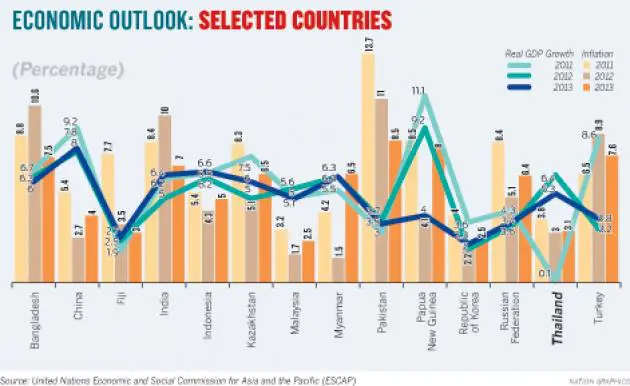
Thailand’s GDP is projected to expand by 5.3 per cent this year, down from 6.4 per cent last year, when its economy exhibited a robust post-flood recovery due to reconstruction and revived business activities. The country saw a decline in growth to only 0.1 per cent in 2011 caused by the severe floods. Inflation is still manageable at 3.1 per cent this year, up from 3 per cent last year.
The Bt2-trillion infrastructure investment, addressing mainly transportation issues, would create short- and long-term benefits and opportunities, he said.
The budget deficit is projected to fall slightly this year from 2.7 per cent of GDP in 2012 and 1.9 per cent in 2011. The tax-to-GDP ratio was 13 per cent in 2012 and 11.8 per cent in 2011. The current account is expected to remain in surplus this year with a sharp slowdown in both exports and imports. Workers’ remittances picked up last year by 10.3 per cent.
The baht’s appreciation, reaching nearly 3 per cent in January alone, has stunted exports and overall GDP growth, he said.
According to the “Economic and Social Survey of Asia and the Pacific 2013: Forward-looking macroeconomic policies for inclusive and sustainable development”, which has been launched in 37 locations around the world, the Asia-Pacific region would see subdued regional growth this year with GDP growth to increase to 6 per cent from 5.6 per cent last year. Regional inflation is likely to remain at 5.1 per cent this year with a risk of an increase in oil and food prices.
The survey found that Asia-Pacific economies had paid a heavy price for the uncertainty in economic and fiscal policies in the euro zone and the United States over the past five years. It estimated a 3-per-cent loss in Asia-Pacific GDP, equivalent to US$870 billion.
Hasan said lower growth could be the “new normal” as the region shows signs of strain from developed-world uncertainty. He estimated the output loss at $1.3 trillion in 2017. The new normal of lower growth underlines the need to make development inclusive and sustainable.
Besides the uncertain global environment, the region is also facing other policy challenges, especially the regional slowdown driven by subdued growth in China and India, and economic insecurity, including decreased job growth and low social security, which is less than 2 per cent of GDP in many countries.
Nearly 1.1 billion of the region’s workforce remains trapped in low quality, which is more pervasive among women and youth than men.
The slowdown in China, the largest individual export market for the rest of Asia-Pacific, has also affected the region. China’s GDP is expected to increase by 8 per cent this year, up from 7.8 per cent last year. About 50 per cent of imports of intermediate goods by China are sourced from developing Asia-Pacific economies and Japan. India is projected to recover somewhat from last year’s low of 5 per cent to 6.4 per cent this year.
The subdued growth in Asia-Pacific would be caused by the region’s structural impediments, such as income inequality, which increased from 33.5 per cent in the 1990s to 37.5 per cent in the latest available year.
Such inequality reduces social development gains by more than 20 per cent. Many economies in the region had also failed to raise sufficient tax revenue despite rapid growth. Asia-Pacific had the lowest tax burden of any developing region in the world. Such low tax revenue restricts governments’ fiscal space. Other structural impediments include infrastructure deficit and unsustainable resource use.
Leaders in Asia-Pacific economies should pledge to adopt forward-looking macroeconomic policies and investment strategies to promote inclusive and sustainable development in the region, he added.
