
Swiss-born returnee helping Myanmar's expansion
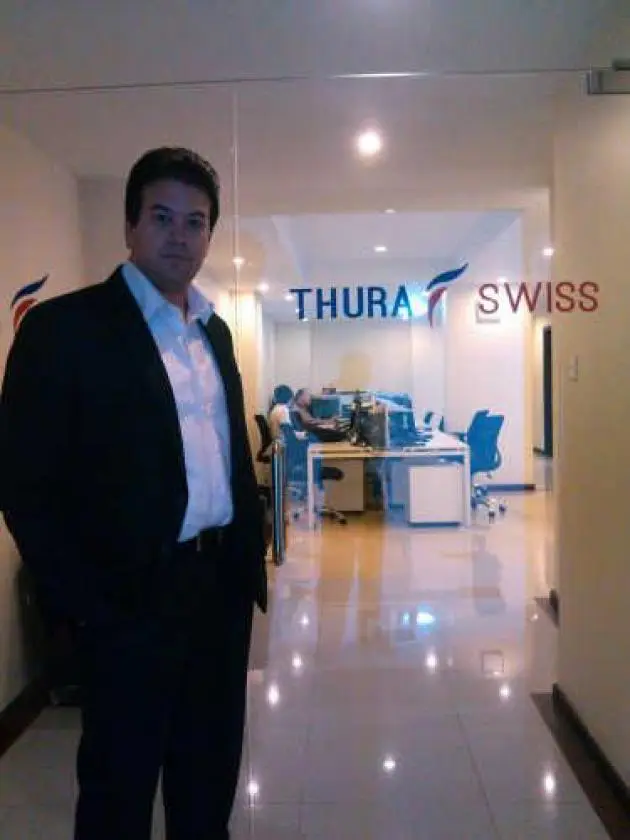


Born in Switzerland, Aung Thura has returned to Myanmar with the aim of participating in the economic development of his parents' homeland.
After many years working with major banks in Switzerland and gaining expertise in business development, financial markets, derivatives and structured-products trading, Aung Thura decided to settle down in Myanmar last year.
Aged 35, he established the Yangon-based research firm Thura Swiss, specialising in market research, consulting and capital markets. The company now offers market research and consultancy services in every sector in Myanmar.
“I had thought about living in Myanmar since I was about 18, but I said I would not come to live here without a proper education and work experience,” said the man who had spent most of his life in Zurich.
With master’s degrees in engineering and quantitative economics and finance, and a doctoral degree in banking, Aung Thura plans to use his knowledge and experience to help develop his country through his business.
“What value would I bring to the country if I came back without a proper education?” said the executive who speaks Burmese, English and German.
“Around 60 to 70 per cent of my customers are from Asia, and a lot of them come from Japan,” said the executive, who once played a leading role in “Shadows of the Past”, a film that he also produced.
The percentage of Asian clients shows the high foreign interest in investing in Myanmar across many sectors.
To Aung Thura, oil and gas, telecommunications, infrastructure and airport construction are the sectors in which companies should now be present in Myanmar, as licences are being offered.
“For manufacturing, it may be too early to come here at the moment, but SMEs need to come and build up their brands now before there is fierce competition in the near future,” he said.
PERCEPTIONS NEED TO CHANGE
Despite the rising number of foreign investors, many still have the wrong perception of the Myanmar market. “Some investors think Myanmar will be a quick win. This is not true. Myanmar already has some established businesses and a lot of competitors,” the executive explained.
Other challenges remain, such as poor transportation, lack of infrastructure, electricity shortages and an underdeveloped banking sector.
To cope with these challenges, foreign investors may need to reform their expectations, he suggested. “If your business-model calculation is in the optimal case, then your calculation will be wrong. You have to do a realistic assessment of the market,” he said.
While the Myanmar government is trying to make the country more investment-friendly, bringing down all these business barriers will take time.
“Don’t expect that Myanmar will be at the same level as Thailand in five years. No way. If we do everything right, we will be in a completely different place in 10 to 20 years,” he stressed.
One major concern of his foreign clients is whether Myanmar will revert to the old system. While this Myanmar national is convinced the reforms are irreversible, he believes there are likely to be political challenges.
“It means Myanmar might not go back, but might stall or might not be moving in one particular direction as different people have different agendas with their own specific interests,” said Aung Thura, who has connections with some of the country’s decision-makers and business leaders.
He added that this could cause Myanmar to lose focus and then |not have a clear strategy for how to continue.
IMPROVING THE BANKING SECTOR
With his educational background and work experience in the banking sector, he sees the importance of improving the banking system in Myanmar.
There is an ongoing discussion on whether to allow foreign banks to operate in Myanmar, as local banks have yet to develop.
“The right approach would be to open up gradually and for a certain period protect local banks in what they can do, such as retail banking. If it cannot be done by local banks, it should be open to foreign banks; for example, investment-banking activities and the stock exchange,” he said.
The Asean Economic Community, which comes into effect in 2015, will be another challenge for the country, as the majority of people still do not even know what the AEC is, he |said.
Moreover, Myanmar is scheduled to open its own stock exchange in 2015, but only the technical infrastructure may be ready by then, he added.
“I have not seen much effort in educating the people to work at the exchange, or being trained to become traders. A lot of companies in Myanmar have not yet expressed their interest in being listed,” he said.
But Aung Thura is here to stay. Whenever the country’s stock exchange is ready, he sees himself involved in the opening of a brokerage firm.
