
Govt stresses stability
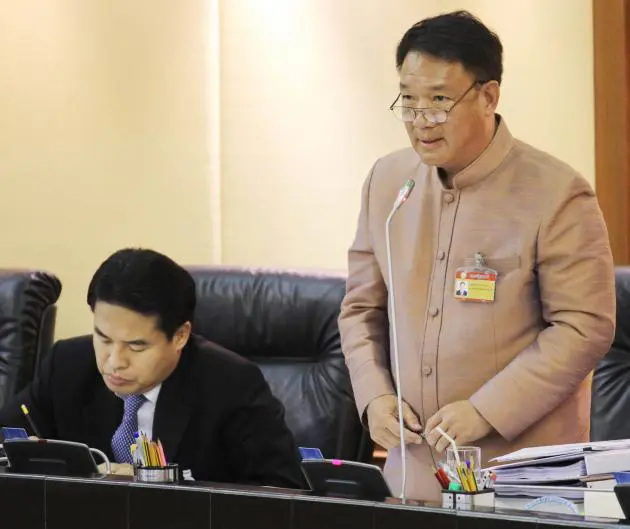


Democrats say the poor are paying more while firms enjoy bigger profits, less tax
The government highlighted eight strategies yesterday when outlining the 2014 fiscal budget, and voiced confidence that the budget would help it achieve economic stability.
On the first of three days in which the Budget bill will be scrutinised, Deputy Prime Minister and Finance Minister Kittiratt Na-Ranong insisted the 2014 budget was set accordingly to economic conditions. He is convinced that the expenditure of Bt2.5 trillion will help the government achieve its goals – and the revenue target of Bt2.275 trillion achievable without tax hikes.

Kittiratt rebutted Opposition fears that taxes would be raised to finance the spending. He said that taxes would not be raised, unless they were needed to control unnecessary consumption. In this regard, the diesel excise tax of Bt1.50 per litre would be levied in October to end a subsidy kicked off by the Democrat-led government. It has been months since the diesel excise tax of Bt5 per litre was waived to keep the retail price below Bt30 per litre.
The finance minister said the government would try to maintain price stability after the increase, while adding that cooking gas price rises would continue as planned, as subsidies lead to wasteful consumption.
Kittiratt insisted that although expenditure in 2014 was a new record high at Bt2.5 trillion, it was only Bt20 billion higher than the 2013 budget. He said spending was set in accordance with revenue collection capability. Revenue next fiscal year is expected to rise by Bt170 billion to Bt2.275 trillion. And the budget deficit was set at Bt250 billion, down from Bt300 billion this year.
Prime Minister Yingluck Shinawatra started the deliberation by highlighting eight strategies, which include preparation for the Asean Economic Community (AEC). About Bt145 billion is allocated for this purpose, or 5.7 per cent of total budget. The other strategies concern national security (winning Bt210 billion or 8.4 per cent); economic stability and sustainability (Bt344 billion or 13.6 per cent); education, quality of life and social equality (Bt850 billion or 33.7 per cent); environment (Bt112 billion or 4.4 per cent); science and innovation (Bt21 billion or 0.8 per cent); and international strategies (Bt9 billion or 0.4 per cent).
An amount of Bt481.6 billion or 19.1 per cent is allocated for emergency spending and human resource development.
Prior to the session, she told reporters that despite criticism of poor results from the expensive rice-pledging scheme, people needed to view the overall picture. She said “fast” post-flood recovery was due to higher income for farmers. The PM urged all to see the integral role – how farm product subsidies moved the entire economy.
Opposition leader Abhisit Vejjajiva yesterday attacked the government for passing burdens to the poor, through the plan to raise the diesel excise tax and cooking gas prices. “The government seemed to ignore the suffering of the poor when preparing the bill,” he said.
Democrat deputy leader Korn Chatikavanij said that while ordinary people would suffer from price rises resulting from higher taxes, businesses and wealthy investors were enjoying benefits from government policies, such as the reduction in corporate tax.
The former finance minister said that while the poor were struggling, listed companies enjoyed higher revenue thanks chiefly to lower corporate taxes.
“The government policies cause wealth to be limited to certain groups and poverty to spread to many other groups,” Korn said.
He urged the government not to borrow for its massive Bt2 trillion in infrastructure projects. It should instead include these projects in the normal budget process in order to ensure transparency. He said the government appeared to want these projects to avoid scrutiny.
Democrat MP Kiat Sitthee-amorn said during the debate that farmers did not benefit from the rice price-pledging project in the current fiscal year, which required Bt600 billion in funds and was set to suffer a huge Bt260-billion loss.
Kiat said it appeared many rice mills involved in the project made much profit. He claimed several luxury Ferrari cars were bought by family members of rice mill owners.
He also attacked “inefficient” oversight of the energy industry, which forced Thais to pay for petrol at prices higher than they should. He pointed out that PTT, a
public company partly owned by the government, made a massive profit of Bt100 billion last year, but this was shared mainly by shareholders.
