
Graft still a major problem, business leaders tell survey


Play
93% of respondents to IOD poll say issue yet to be tackled
Most of Thailand’s business leaders acknowledge that corruption has been rampant since 2010 at high to very high levels, jeopardising the country’s long-term business credibility, according to a release by the Thai Institute of Directors (IOD).
According to IOD survey on 1,066 companies during January-April this year on the corruption situation in Thailand, 93 per cent of the respondents said that the corruption has yet to be solved and the level of the problem seriousness is at the critical level.
The survey was conducted from January to April in cooperation with GFK MarketWise. The number of respondents totalled 1,066, up from 1,007 in 2010. They worked in both non-listed and listed companies, in Bangkok and the provinces, that generate sales of up to Bt50 billion annually. The findings of the IOD survey reflect studies by international organisations. Several have found that Thailand is still plagued by corruption, considered a factor that could undermine the overall investment climate.
Dr Bandid Nijathaworn, IOD president, said there was still hope to find a solution. The survey found that 25 per cent of participants believed corruption could be solved in the future, compared with only 12 per cent in 2010. They pointed out that curbing corruption was not the task of any single body, but of all three parties – government, politicians, and the business sector – to work together more cohesively.
To crack down on corruption, 75 per cent believe that the private sector can play a major role. A total of 93 per cent, up from 69 per cent in 2010, expressed some readiness to join collective action against graft. Those who “definitely wanted’’ to take part in such action rose to 51 per cent, from just 14 per cent in 2010.
They agreed that corruption cost their businesses. The survey found that 63 per cent said it would have an impact on their operation at the high and very high levels, 54 per cent said that the corruption has added 10 per cent cost to their business operation, while 8 per cent of the respondents add 30 per cent to their operation.
The processes that could lead to corruption include procurement, business registration and bidding for state projects, as well as the procurement processes between private companies. Twenty-two per cent of respondents said the highest chance of corruption was in tendering with the government sector, while 14 per cent said the registration and permission process, and 10 per cent pointed to procurement processes within the private sector.
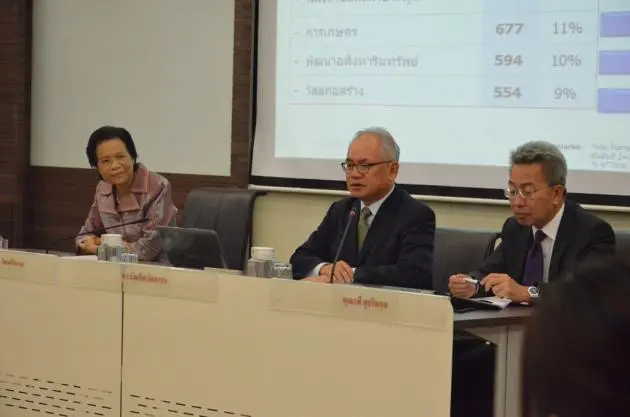
The industries with a high chance of being involved in corruption included telecommunications (15 per cent), energy and public utilities (14 per cent), agriculture (11 per cent), property development (10 per cent), and construction materials (9 per cent).
Respondents said there were several causes of corruption. They included legislation or regulations that allow state official to use their own judgement (19 per cent), followed by a political system that lacks transparency and is difficult to investigate (15 per cent), political benefits (15 per cent), weak law enforcement (11 per cent), and lack of ethics of authorities (10 per cent).
They said corruption posed risks to the country economically, socially and democratically. Reducing regional effective competitiveness was its biggest impact according to 21 per cent of respondents, followed by a fall in social morality (20 per cent), giving the country a bad image (14 per cent), slowing economic growth (11 per cent), and weakening governance (9 per cent).
