
Interconnectivity critical to unlocking Asean's vast growth potential


Play
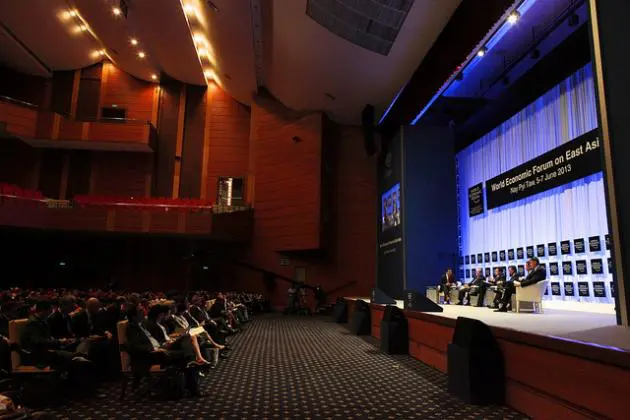
Nay Pyi Taw, Myanmar, 6 June 2013 - On the opening day of the World Economic Forum on East Asia, Asean business and political leaders emphasized the need for greater connectivity and regulatory harmonization to unlock Asean's vast growth potential, now a
In a session on the region’s networked future, participants heard that growth in Asean will exceed expectations, but only if the regional bloc synergizes supply chains and prioritizes regional unity.
“There is no room for regulatory nationalism in Asean,” noted Cesar V. Purisima, Secretary of Finance of the Philippines. Asean’s strength, he noted, is in its role as a regional trading bloc and must not be derailed by bilateralism.
Key ways to achieving a more integrated and efficient Asean include streamlining regional export and import processes, creating a body solely responsible for boosting supply chain competitiveness – already existent in the banking and telecommunications sector – and improving regulatory harmony.
On the planned National Single Window, an initiative to streamline regional customs data by 2015, Kittiratt Na-Ranong, Deputy Prime Minister and Minister of Finance of Thailand, said that, “Asean is committed to overcoming political challenges to become more interconnected.”
Participants also said that boosting regional supply chains will generate the capital necessary to fund critical infrastructure. They agreed that this must happen in a way that benefits Asean’s population.
But in a region that encompasses huge disparities in wealth – with affluent Singapore alongside lesser developed countries such as Laos and Myanmar – Asean’s perceived weakness could also be its biggest strength.
“The secret,” said Yorihiko Kojima, Chairman of the Board, Mitsubishi Corporation, Japan, a Co-Chair of the World Economic Forum on East Asia, “is that Asean [countries are] at different stages of development, allowing companies to be more selective about where they set up production bases and focus on value add across the region.”
Panellists agreed that, a decade from now, people will still be saying that Asean, a beacon of stability amid global economic turbulence, will remain the most exciting investment destination.
Looking ahead to unlocking the region’s huge growth potential, Harish Manwani, Chief Operating Officer, Unilever, Singapore agreed. “Asean,” said Manwani, “is bigger than Asean even imagines.”
Over 1,000 participants from 55 countries are taking part in the World Economic Forum on East Asia, held for the first time in Nay Pyi Taw, Myanmar. The meeting welcomes over 100 public figures representing 15 countries, including heads of state or government from Laos, Myanmar, the Philippines and Vietnam. More than 550 business leaders, over 60 Global Growth Companies and nearly 300 young leaders from the Forum’s Young Global Leaders and Global Shapers communities, together with other members of civil society, academia and media are convening to discuss the challenges and opportunities facing Myanmar and East Asia today.
