
SET soothes investors as Asia bourses fall on US sell-off
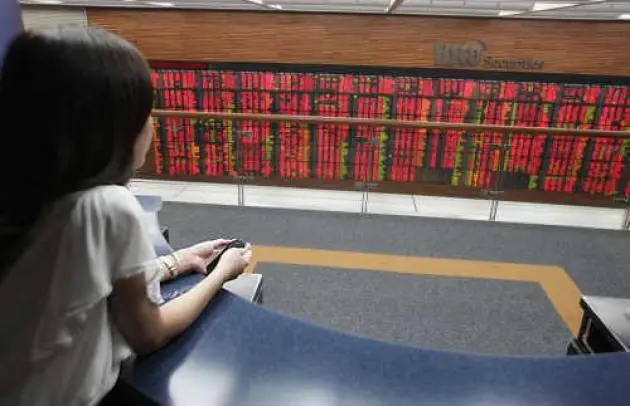


The Stock Exchange of Thailand yesterday rushed to soothe investors after the prospect of the US scaling back bond purchases triggered a retreat by foreign investors, dragging the SET Index down by 9.32 per cent from its record high of 1,643.40 on May 20.
Asian markets sank following a sell-off on Wall Street, where dealers were spooked by disappointing US jobs data.
The dollar rose slightly after shedding around 1 per cent against the yen in New York, while expectations that the Federal Reserve will start to pull back on its monetary easing also pushed the US unit up further against its Australian counterpart.
Tokyo fell 0.85 per cent, or 110.85 points, to 12,904.02, extending an almost 4-per-cent decline on Wednesday due to disappointment at Prime Minister Shinzo Abe’s latest plan to boost the economy.
Sydney shed 1.12 per cent, or 54.0 points, to end at 4,781.2, while Hong Kong lost 1.05 per cent, or 230.81 points, to close at 21,838.43. Shanghai was down 1.27 per cent, or 28.82 points, at 2,242.11.
Seoul and Jakarta were closed for public holidays.
Regional investors took their bets off the table after payroll firm ADP reported that the US private sector added 135,000 jobs in May, less than the forecast 157,000.
That came as the Fed’s closely watched Beige Book report on US economic conditions said growth continues to be "modest to moderate", suggesting steady but still slow expansion.
SET president Charamporn Jotikasthira told an urgent press conference that yesterday’s plunge was in line with other stock markets across the globe, but the economic fundamentals and corporate earnings here remained strong.
From May 23 to the present, the Thai gauge dropped 6.6 per cent. Japan’s Nikkei Index sank 16-17 per cent and the Philippines benchmark index slumped 17 per cent.
The Philippines, Indonesia and Thailand have seen their stock markets showing the lowest returns after foreign investors’ consistent net selling on concern the US Federal Reserve would scale back its bond purchases under quantitative easing. In the past two weeks, overseas investors have been net sellers of stocks worth US$2.3 billion in the three markets. The Thai bourse has seen the highest net sell-off of Thai stocks worth $769 million.
The SET Index yesterday slumped 32.45 points to 1,490.21.
Despite the recent sharp drops, so far this year the SET has gained 9.4 per cent and Indonesia’s benchmark index 15 per cent.
The Thai exchange was not planning any measures to contain the market slump and the recent dives were seen as a buying opportunity, Charamporn said.
Moody’s hint of a possible downgrade in Thailand’s ratings would have a minimal impact on the Thai bourse, given unchanged fundamentals, he said.
