
World's help sought to tackle challenges


Play
The Asian Development Bank's US$500 million (Bt15 billion) infrastructure fund, the Tata Group's training centre and Microsoft's distribution partnership in Myanmar - all were unveiled on the sidelines of the World Economic Forum on East Asia 2013, the
Two years after political and economic reforms were kicked off, it was the first time that Myanmar President Thein Sein and a number of his ministers mingled with a large number of global political and business leaders, as well as opposition leader Aung San Suu Kyi and local political activists.
The message is clear: Myanmar is desperate for international assistance, financial and non-financial, to pursue economic prosperity and peace.
The international community in return enthusiastically offered the country its full support. Of a total of 29 sessions, seven – 25 per cent – were devoted to Myanmar issues. Rooms were packed for sessions that featured President Thein Sein or opposition leader Suu Kyi. Their views were in the spotlight, given that both are expected to run for the presidency in 2015.
While Thein Sein promised further reforms to win more international assistance, Suu Kyi – who announced her decision to run for president if the constitution is amended to allow her to stand – was specific on what kind of help Myanmar urgently needs and what kind of investment the country welcomes the most.
At a press conference, Suu Kyi told local and foreign reporters that anywhere in her country, jobs are the most urgent requirement as the unemployment rate is as high as about 25 per cent.
That is followed by water, roads, electricity, education and health coverage.
The opposition leader apparently looked at the “investing frenzy” with great doubt. Expressing dissatisfaction over the political and economic reforms, which still fails to be “people-inclusive”, she said foreign investors are just “investigating” amid concerns of the safety of their investment.
“It’s not investment but investigation. Let’s stop the frenzy… They are here to see if the time is right to invest… The reforms have not brought what our people want,” she said.
Suu Kyi admitted it is till hard to engage business people to create jobs. What she could do for her constituency now is to find them water. As a politician, she is pushing for constitutional amendments of the legal voting clause. She is also pushing for an amendment in the Foreign Investment Law and the setting of the minimum wage.
She is aware that changes are rare amid resistance from the ruling party. A warning to them is “if coincidences happen too often, people won’t believe it”. At one session, she admitted that political and economic reforms were inseparable.
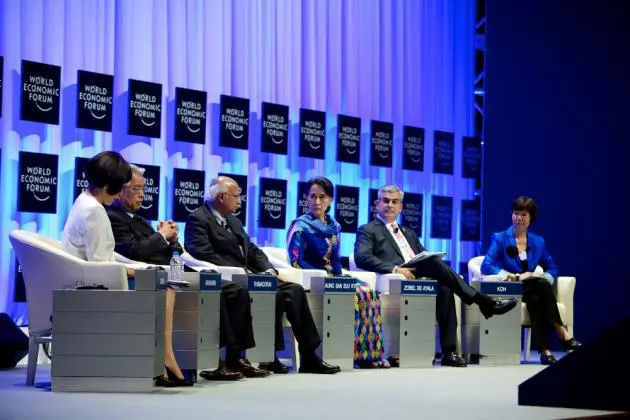
“Inclusive development is necessary for a country with many ethnic minorities like Myanmar. Political change and economic development must be closely linked. They can’t be divorced. Without economic development, there will be political changes,” she said at the “Taking Myanmar to Work” session.
During this, she highlighted the urgent need for vocational and on-the-job training, particularly for those aged over 40, who had suffered from poor education in the past two decades when Myanmar was under strict military rule.
“We are ready to help,” said Hiroto Arakawa, vice-president, Japan International Cooperation Agency (JICA), at the session.
Aside from the $500 million aid for “quick-fix type power projects” in the Yangon area and education and other development programmes among the country’s ethnic groups, Japan will also provide loans to build infrastructure in a new special economic zone in Myanmar and open a vocational training centre in August.
Subramanian Ramadorai, vice chairman of India’s Tata Consultancy Services, said the company has set up the Myanmar Institute of Information Technology in Mandalay, patterned after the prestigious Indian Institute of Technology, which has produced some of the world’s top engineers and scientists.
“The first batch of students will be admitted in September this year,” he said, adding that the school will train thousands of IT specialists in four or five years.
“The private sector must be part of the force and must create jobs,” he said.
Jaime Augusto Zobel de Ayala II, chairman and CEO of the Philippines’ Ayala Corp, admitted that Myanmar shared a similar problem with the Philippines. With nearly a 100-million population, many youth are unemployed. He urged Myanmar to seriously adopt the public-private partnership scheme to “get private capital due to limited resources against huge demand [for development]”.
He agreed that the country’s education system must be upgraded, but with a balance of right workforce for different stages of development.
In the years ahead, Myanmar’s economy is expected to prosper particularly with the launch of the Asean Economic Community (AEC).
“I’m very positive about everything happening in AEC. Myanmar is getting itself on the map,” he said.
The JICA executive noted that the Myanmar people must be patient as the country needs a holistic approach. For example, to support economic development, the country first needs infrastructure. Plus, Myanmar also needs to learn from other countries, to avoid repeating others’ failures.
Panellists see the need for hiring experts for help in the start-up period. Suu Kyi herself supports the return home of 3 million Myanmar workers overseas, even on a temporary basis to help transfer knowledge to their countrymen.
