
Phitsanulok farmers have mixed views on rice pledging scheme


Play
Some cite better incomes; others worry about losses, low development
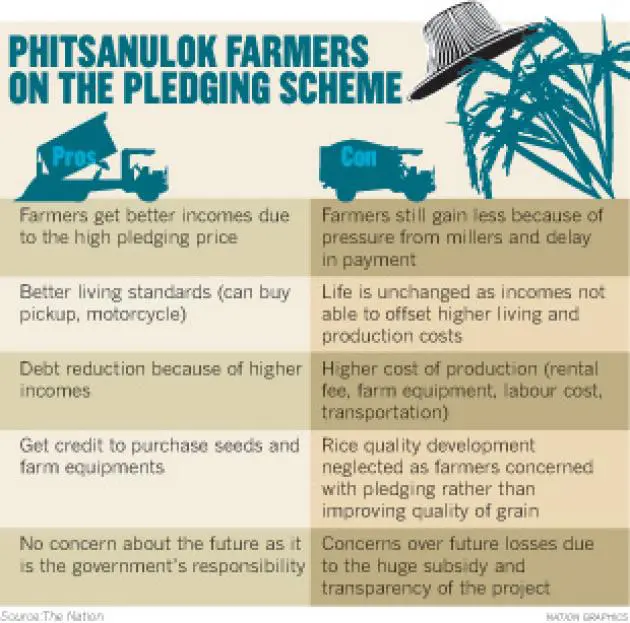
While some rice farmers express satisfaction with the government’s pledging scheme, as it has helped them earn better incomes, others say their income has not changed and they are worried about the scheme’s huge losses and the low development of rice farming in the long run.
The Nation interviewed farmers in Phitsanulok and found that they held mixed views of the government’s rice-pledging project during the past two years. They acknowledge that they are part of today’s heated debate over the programme and want to express their point of view on whether they want to see the country sustain losses or want the subsidies to continue.
Rice growers are one of the biggest groups of farmers, with about 17 million of them or 3.4 million households.
Supaporn Poomdee, a farmer in tambon Choompoo, said yesterday that she had not benefited from the pledging policy because it was complicated and the system was not running smoothly.
“I have to sell my rice in the market and get only Bt8,000-Bt8,500 a tonne because the setting up of the pledging system has been delayed. I also know about the losses of the government and am highly concerned about transparency and where the budget to help farmers has gone,” she said.
Despite the high payments from the programme, the cost of production has soared over the past two years.
For instance, Supaporn, who owns about 20 rai (3.2 hectares) of land and needs to rent 20 more rai to grow rice, said rental costs per crop have jumped to Bt1,000 a rai from Bt500 in the past three years. Labour costs have also doubled from Bt100-Bt150 a day to Bt300.
She said farmers were still poor despite the scheme, while the middlemen and millers were getting wealthy.
Yung Munchaona, a farmer in tambon Chainam, said he was facing delayed payments and lower returns than the government’s pledging price. He said he had not developed the quality of his rice but instead had accelerated production to ensure participation in the project.
“I have worried about the current losses of the pledging scheme and the future of the country as well as the continuation of the pledging project. Although the return is quite high under pledging, I do not want to earn more in the short term if the country is facing losses and failure in the long run,” he said.
The cost of leasing farmland has gone up from Bt700-Bt800 per rai per month to Bt1,000.
Niew Chaiwut, a farmer in tambon Watchan, said he gets a bigger return from pledging, but the cost of production has also increased.
Agencies promoting the production of quality rice have paid little attention to helping farmers develop rice quality.
“If I do not quickly raise rice in a short period, I will miss the chance to join the pledging,” he said.
Ronnachit Monthonpisut, who is also a farmer in Phitsanulok and the owner of 100 rai of farmland for rice, said the pledging programme had been a blessing for farmers. He can make more than Bt10,000 a rai, up from Bt7,000-Bt8,000 in the past.
The pledging project helped him to enjoy a better standard of living. He doesn’t believe that the government will face losses from the scheme, as the government is supposed to be rich.
Pranom Chueypetch, a farmer who owns 34 rai in the province, said she was able to reduce her debt during the past two years of pledging because of the higher payments. The cost of production has increased, but as long as the government sets a high pledging price, it should benefit farmers.
The pledging scheme is operating in the red, but the government should be able to solve the problem and it is fully responsible for farmers, she added.
