
SET faces further volatility


Play
Outfows, internal risks among negative factors
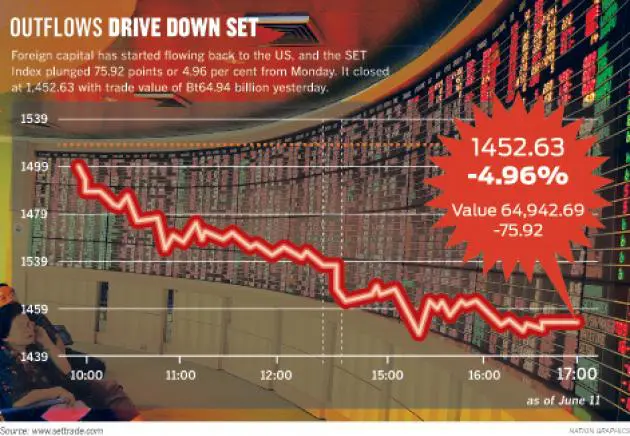
Thailand and the rest of Asia are bracing for more volatility, as foreign capital started to flow back to the United States on the back of improvements in some economic indicators. This comes at a time when Thailand is facing internal risks, from the rice-pledging scheme to intensifying anti-government sentiment.
Asian stock exchanges ended lower yesterday because of foreign sell-offs. On average, Asia-Pacific bourses showed a 0.7-per-cent slide. Leading the pack was the SET Index, which dropped 4.9 per cent (75.92 points), the most since October 2011, to 1,452.63. Trailing the Thai bourse were the Philippines, which plunged 4.6 per cent, and Jakarta, down 4.2 per cent.
Yesterday, foreign investors were net sellers on the Stock Exchange of Thailand, with their sells reaching Bt5.48 billion. Since June 1, net sells have been Bt28.19 billion, and the year-to-date figure is Bt49.28 billion.
The plunge in the index prompted SET president Charamporn Jotikasthira to urge investors to stay calm.
“Don’t panic. If your focus is placed on stocks with good fundamentals, the downward movement is a good opportunity,” he said.
Kavee Chukitkasem, assistant managing director of Kasikorn Securities, foresees a downward trend for the Thai market until the end of the third quarter, with the possibility that the SET Index will fall to 1,400 points in light of external and internal risk factors.
While investors are fretting about the premature end of quantitative easing (QE) in the United States and Japan, the rice-pledging scheme is now at the centre of all internal risks, he said.
“Concerns on QE led to the higher-than-expected loss in the index, beyond the market’s fundamentals. Investors also focus on the rice-pledging scheme, which may raise the public debt and persuade Moody’s Investors Service to downgrade Thailand’s rating. Plus, in the third quarter, the Constitutional Court will rule on whether the government’s moves on charter amendment are constitutional,” he said.
He expects the dust to settle by the fourth quarter, and the market should recover on the back of strong earnings of listed companies. Kasikorn Securities expects 15-per-cent earnings growth this year and 10 per cent in 2014. It maintains the 2013 target for the SET Index at 1,700 points and is reviewing the 2014 target, which is now at 1,900 points.
Visit Ongpipattanakul, an investment strategist at Trinity Securities, told Bloomberg that outflows of foreign funds from Thailand, the Philippines and Indonesia should continue for some time because of concerns over QE in the US.
The US kicked off QE after the 2008 financial crisis, injecting more than US$2 trillion (Bt60 trillion) into its economy. As other developed economies joined the trend, global markets in the past few years were flooded with excess liquidity. Emerging stock markets were booming, while currencies rose against the US dollar.
Some economic indicators recently showed improvement, though, which may persuade the US Federal Reserve to switch off the money injection before next year. As outflows are returning to the US, the dollar has regained strength and liquidity in emerging markets is squeezed.
Standard and Poor’s Ratings Services on Monday revised the US economic outlook from negative to stable, lessening the chance of a downgrade in the short term to less than one in three. In a statement, S&P said the credit strengths of the US included its resilient economy, its monetary credibility, and the US dollar’s status as the world’s key reserve currency.
“Similarly, in our view, the US’s credit weaknesses, compared with higher-rated sovereigns, include its fiscal performance, its debt burden, and the effectiveness of its fiscal policy-making.”
Currencies from Brazil to Thailand have weakened in the past month. The baht, which hit a 16-year high at 28.5 per US dollar in April, yesterday weakened to near 31. The currency closed last year at 30.60.
After the government’s pressure on the central bank to cut its policy interest rate last month to tame foreign-capital inflows, the Bank of Thailand now sees a reversal. BOT Governor Prasarn Trairatvorakul acknowledged yesterday that foreign capital had started to flow out of Thailand.
Urging companies with foreign-exchange exposure to stay on full alert, Prasarn said the BOT’s Monetary Policy Committee and Financial Institutions Policy Committee would convene for the first time this year to discuss Thailand’s economic stability on Friday.
One of the topics of the upcoming meeting will be commercial banks’ lending and deposit rates after the MPC cut the policy rate by 25 basis points to 2.50 per cent on May 29. The banks have not yet responded to the rate cut.
Prasarn said there could be several factors, such as market competition and the current 13-per-cent rate of loan growth, affecting commercial banks’ lending and deposit rates.
“It’s possible for them to lower interest rates. However, loan growth is relatively high and they may be concerned over liquidity.”
