
Cartons can now become roofs


Play
Firm sets up collection centres nationwide so used packs can provide shelter to the needy
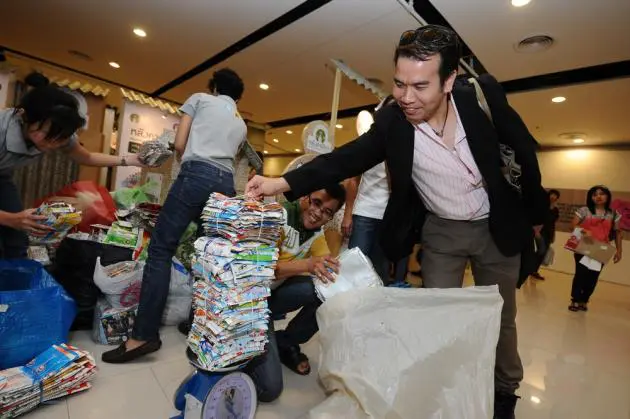
In June 2010, Tetra Pack Thailand collaborated with the Princess Pa Foundation, the Thai Red Cross Society and Big C Supercentre to kick off the “Green Roof Project for Princess Pa Foundation”. Under this project, used cartons dropped off at Big C outlets and other collection points are transformed into roofing sheets.
Up until April, the project had collected 555 tonnes or approximately 55.5 million used beverage cartons that will be turned into some 28,000 green roofing sheets.
“With positive feedback from all partners and stakeholders, the campaign, which was originally scheduled to run from June 2010 to June 2013 has now been extended by at least another three years,” Tapanee Junhom, communications and public affairs manager, said.
Through the foundation, hundreds of permanent homes for flood victims and other needy communities in provinces such as Angthong, Lop Buri, Krabi, Surat Thani, Nakhon Si Thammarat, Mae Hong Son and others now have a green roof over their heads.
For Tetra Pak, this is a way of reducing carbon emission as recycling used cartons significantly cuts down on carbon dioxide because they do not need to go to landfills or incinerators.
According to Tapanee, up to 4,000 volunteers across the country help collect used cartons. In 2012, 25 per cent of used cartons, or approximately 13,000 tonnes or 1,300 million cartons, were collected for recycling in the Kingdom.
“Tetra Pak sees the benefits of the project in sending a strong message to the public at large that beverage cartons are recyclable. One does not just help the environment, but also society through the Green Roof project by just sending in used cartons for recycling,” she said.
For the packaging company, innovative products and awareness are the key. In 2010, it introduced cartons bearing a stamp from the Forest Stewardship Council (FSC), an independent, non-governmental, non-profit organisation that promotes responsible management of the world’s forests. This carton was also the first package to win the Carbon Reduction Label from a joint-working committee of Thailand Greenhouse Gas Management Organisation and Thailand Environment Institute (TEI) as its production process reduces the emission of CO2 by 10 per cent.
Aside from the commitment to cut down on its carbon footprint across the value chain by developing sustainable products and minimising renewable materials, Tetra Pak sets out to raise awareness and build a sustainable collection and recycling system.
“Now that the public is aware that cartons are recyclable and sellable, they can choose to either support projects like Green Roof by sending in used cartons to be transformed into roofing sheets for those in need or sell used cartons to waste dealers.”
In collaboration with recycling firm Fiber Pattana, Tetra Pak initiated provincial collection centres in 2011. The centres, which accept used cartons from waste dealers nationwide, also focus on the issues of cost-efficiency and low energy usage when moving goods to the Fiber Pattana recycling plant in Samut Prakan.
Each centre follows different models. Some might work in collaboration with local alliances such as Sub-district Administrative Organisations and a municipality that has the equipment, facilities and waste-collection network. Others could be through collaboration with local waste dealers or through general volunteers who want to take part in saving the environment.
With the focus to setting up collection centres in provinces where there is a high consumption of beverage cartons, the network now covers major cities like Chiang Mai, Ubon Ratchathani, Phuket, Si Sa Ket and Sakhon Nakhon.
Through the 10 centres set up so far, up to 408 tonnes of used cartons was collected in 2011 and almost 700 tonnes in 2012. The centres also educate volunteers, students and communities about recycling beverage cartons.
By 2020, Tetra Pak aims to cap the climate impact across the value chain at 2010 levels.
“At Tetra Pak, everything we do is driven by a simple promise: to protect what’s good. That commitment relates to not just ensuring safety of the food we eat and drink, it’s also about minimising our impact on the environment. We believe we are on the right track,” Tapanee said.
“We plan to achieve 40 per cent recycling rate worldwide. For Thailand, in 2011, our used carton collection volume was more than 20 per cent and 25 per cent in 2012, which was a real achievement considering how carton recycling in Thailand only started a few years back. Yet, we still need to step up to ensure that we will meet our recycling target every year towards 2020.”
